
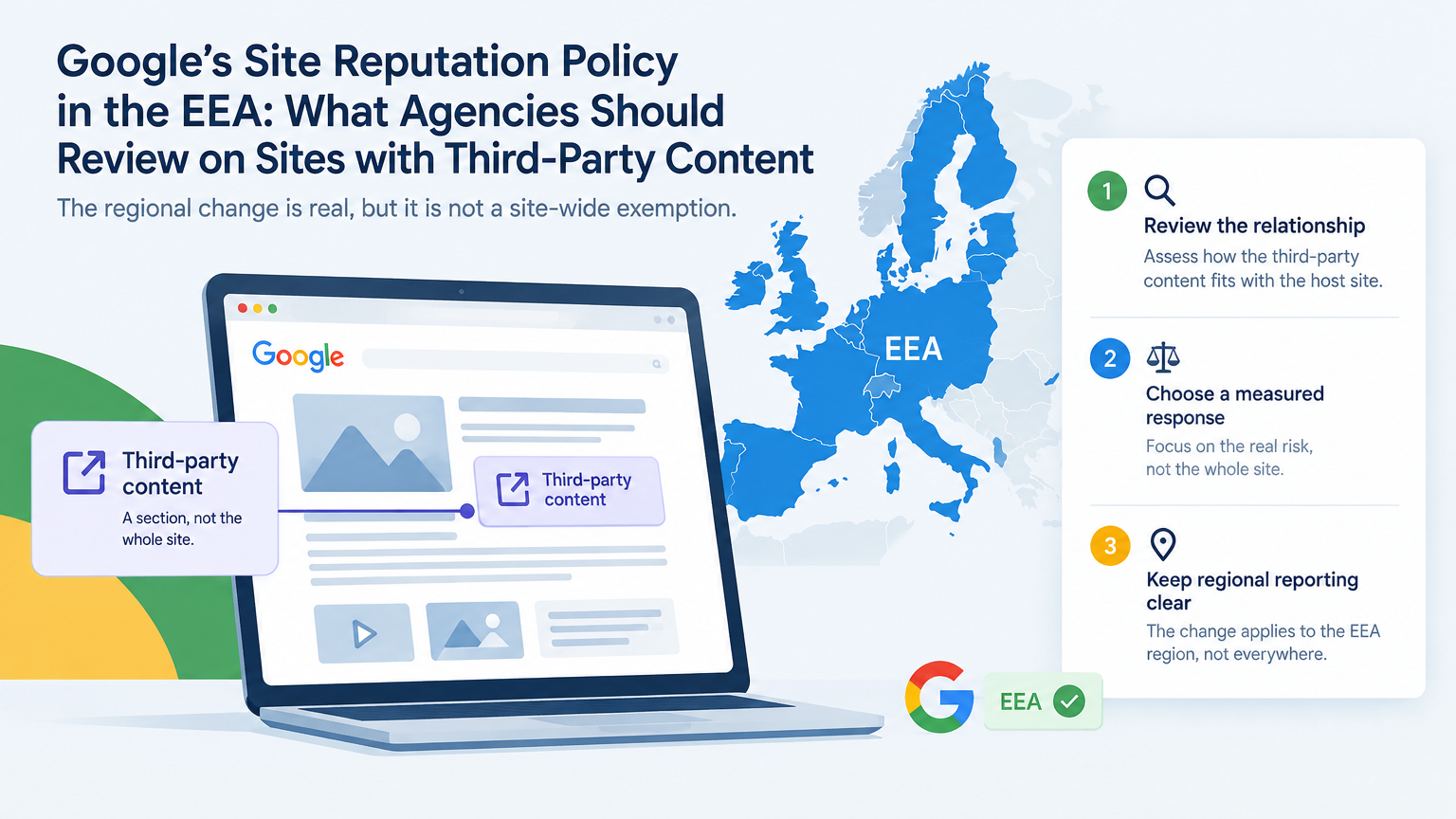
The regional change is real, but it is not a site-wide exemption
Google’s policy addresses third-party content published on a trusted site to exploit that site’s reputation and gain higher rankings in Search. For client work, the key question is not simply “Is this third-party content?” Ask what the section is for, how it fits the host publication and how it is actually managed.
The regional effect matters when explaining the announcement. For users outside the EEA, a site reputation manual action affects Search results for the specific part of the site concerned, not the rest of the site. For users in the EEA, the manual action has no effect on Search results. A page may be viewed globally and receive a manual action, while the effect described here is limited to Search results shown to users outside the EEA. Google may separate the affected part from the rest of the site, after which it may rank separately over time. This is not a guarantee of unchanged performance: the announcement gives no forecast for visibility or timing.
A section can involve contributors, partners or commercial arrangements without the label alone settling whether there is a concern. Review the relationship between the section and the host’s publication. Is the material genuinely part of what the site publishes for its audience, or does the section mainly let another party use the host’s reputation to gain search visibility?
Google’s 2024 clarification is useful context: third-party content is not prohibited simply because it is third-party. The concern is publishing it to exploit the host’s ranking signals to manipulate Search rankings. First-party involvement or oversight alone does not put an arrangement outside the policy. Editorial ownership, a commercial label or contributor status is context, not a safe harbor. Assess the content’s purpose and actual use of the host’s reputation. Google says it considers multiple factors and does not simply accept a site’s account of how content was produced.
In a client workshop, work through questions like these:
Purpose: What audience need does the section serve, and why does it belong on this site rather than simply using the host’s perceived authority?
Editorial relationship: Who sets the brief, chooses subjects, reviews material and makes the final publishing decision? Is there a meaningful connection to the host’s publication, or is the host mostly providing distribution?
Ongoing responsibility: Who maintains accuracy, handles updates and decides what should be removed or corrected? Can the client explain how the section is governed, rather than only who supplied the articles?
Commercial context: What role do the third party and any commercial arrangement play? Does the content serve the site’s readers as well as the contributor’s objectives?
Section boundaries: Which pages and parts of the site are involved? A clearly identifiable area gives the team a more useful unit to review than a broad claim about the entire domain.
These are diagnostic prompts for sound client work, not a formula that guarantees how Google will assess a site. They turn a vague discussion about “parasite SEO” or “third-party content” into a concrete review of purpose, editorial control and site structure. Keep examples and conclusions tied to the client’s actual publishing arrangement, not assumptions based on a URL folder, content label or partnership announcement alone.
Sources: Update to the Site Reputation Policy; Cosa devono sapere i creator sul web sull'aggiornamento principale di marzo 2024 e sulle nuove norme relative allo spam; Robots Refresher: Future-proof Robots Exclusion Protocol
Start with the section’s role, not its label
Treat the regional difference as a prompt for a targeted review, not a reason to rush into removal. Google’s announcement does not call for removing third-party content across the board, and the EEA treatment does not make a section low-risk in every market.
Start with a bounded inventory of the pages in scope. For each, record who commissions and approves it, who maintains it, its role for the host’s audience, and whether it supports an active campaign, offer or customer journey. This gives the client a practical review unit and makes commercial dependencies visible before any change.
Then choose the next step based on what the review establishes:
If ownership, purpose or the page set is unclear, resolve those facts and identify a decision owner before recommending a change.
If the section genuinely serves the host publication’s readers, decide whether clearer editorial responsibility, stronger review and maintenance, or more useful reader-focused content is needed.
If the section exists mainly to let another party borrow the host’s reputation, address that underlying publishing purpose rather than relying on a label change or URL move.
Record the rationale and any unresolved questions, especially before changes that affect live campaigns or wider operations. The review informs the client’s publishing decision; it does not predict Google’s assessment or search performance.
Sources: Update to the Site Reputation Policy; 更新網站信譽濫用行為政策; Cosa devono sapere i creator sul web sull'aggiornamento principale di marzo 2024 e sulle nuove norme relative allo spam; Robots Refresher: Future-proof Robots Exclusion Protocol
Choose the response after you understand the publishing arrangement
Once the publishing arrangement is understood, turn the review into an action plan the client can own. A useful recommendation states why action is proposed, which pages or section it covers, who will make and maintain the change, and what the team will review afterward.
Depending on the findings, options may include changing how the section is commissioned and governed, revising content that does not serve the publication’s readers, restructuring the area, or removing material the client no longer wants to publish. These are client-side choices, not measures Google prescribes or guarantees. Treat governance improvements as ways to improve the publication, not as policy clearance: more editorial involvement does not by itself settle how Google will assess the arrangement.
Before a significant change, preserve a clear record of the decision and affected URLs. Agree with the client on the section’s intended role, who owns future editorial decisions and what evidence would prompt another review. If a manual action is already in place, do not assume that noindexing pages or moving them to a subdirectory or subdomain on the same domain will clear it. Google says noindexing does not automatically remove a manual action, and moving content within the same domain does not resolve the underlying issue and may be viewed as an attempt to circumvent the policy. The site owner should respond to the action in Search Console; if content is moved, Google says a reconsideration request is also needed to remove the manual action. A URL move is not a shortcut, and the available process does not guarantee an outcome. Consider the commercial and operational implications before implementation.
Set a follow-up point that matches the decision. For example, review whether the agreed editorial process is being applied, whether content has been updated or removed as planned, and how the relevant site area performs by market. Treat performance as an observation, not proof that a particular change caused a result. This gives the client a clear next decision without implying that any action guarantees a search outcome.
Sources: 更新網站信譽濫用行為政策; Cosa devono sapere i creator sul web sull'aggiornamento principale di marzo 2024 e sulle nuove norme relative allo spam
Report by market and site section, not by domain alone
When interpreting search performance, keep three dimensions visible: the user’s region, the site section and the time period. A domain-level view can hide the fact that Google’s announcement concerns a particular affected portion of a site, and a blended global view can obscure the announced regional difference.
For client reporting, separate the following where the available data allows:
Market: EEA users and users outside the EEA. Keep the market definition consistent across comparisons and be clear about what the data represents.
Site area: The section concerned, relevant pages and, where useful, the rest of the site as a comparison. Do not present a section-level issue as a whole-domain outcome.
Search observation: The period and search performance being reviewed. A change in regional visibility can be recorded as an observation; by itself, it does not identify why the change occurred.
Policy status: Any manual-action information the site owner receives in Search Console, attached to the affected site area and the dates being discussed.
The announcement does not provide a forecast for how much visibility a section will retain, how quickly separation in Google’s systems may happen, or what its independent ranking will look like. Avoid promising an EEA recovery, treating a performance difference as proof of a manual action, or attributing a movement to the policy without evidence linking the observation to that action.
A useful client report can make this straightforward: state which market and section you reviewed, note any relevant Search Console notification, show the observed performance for the agreed period, and identify what should be checked next. If reporting systems cannot isolate a region or section cleanly, explain that limitation rather than making the data appear more precise than it is. The goal is not to make every report complex. It is to keep the unit of analysis aligned with the scope of the announcement and the client’s actual decision.
Sources: Update to the Site Reputation Policy
If a manual action is reported, use the process rather than guessing
Google says site owners will continue to receive notifications in Search Console when a manual action is applied. If a client reports a concern, start by confirming the notification and understanding which part of the site it concerns. Avoid inferring a manual action from a drop in traffic alone, and avoid treating a policy discussion or a third-party publishing arrangement as proof that an action exists.
If the site owner believes the action was applied in error, Google says a reconsideration request remains available. Eligible sites can, following reconsideration, also bring disputes to mediation. Keep the stages in that order when explaining the available route: first review the notice and affected area, then consider reconsideration, and only describe mediation as an option for eligible sites after that step. The announcement does not say that every site qualifies for mediation or that any part of this process guarantees a particular outcome.
For agency delivery, keep the client’s decision-makers informed and the working record specific: the notification received, the section and pages identified, the client’s review of the publishing arrangement, the action taken and the dates of any follow-up. Separate confirmed information from hypotheses in internal notes and client communications. This helps the team respond to the actual issue instead of letting a regional visibility pattern substitute for a Search Console notice.
Keep the conclusion within what the announcement supports
The announcement concerns Google Search enforcement under the site reputation policy. It does not establish that AI-answer visibility, citations or recommendations change in parallel. If a client is also tracking visibility in AI experiences, keep that work as a separate observation: this policy announcement is not evidence that an answer will include, omit or rank a particular source.
A useful client decision is therefore grounded in the actual publishing relationship and the evidence available for the affected market and site area. Review the section before prescribing a response. If a manual action is present, use the notice and the available process. In reporting, keep market, section and time period attached to the observation. That approach lets an agency respond to the EEA change without overstating what it means, overlooking performance outside the EEA, or making a sweeping content change before understanding the client’s editorial model.
Sources: Update to the Site Reputation Policy; 更新網站信譽濫用行為政策; Cosa devono sapere i creator sul web sull'aggiornamento principale di marzo 2024 e sulle nuove norme relative allo spam
Sources
- Update to the Site Reputation PolicyGoogle Search Central · Accessed Explore publications using this source
- 更新網站信譽濫用行為政策Google Search Central · Accessed Explore publications using this source
- Cosa devono sapere i creator sul web sull'aggiornamento principale di marzo 2024 e sulle nuove norme relative allo spamGoogle Search Central · Accessed Explore publications using this source
- Robots Refresher: Future-proof Robots Exclusion ProtocolGoogle Search Central · Accessed Explore publications using this source