
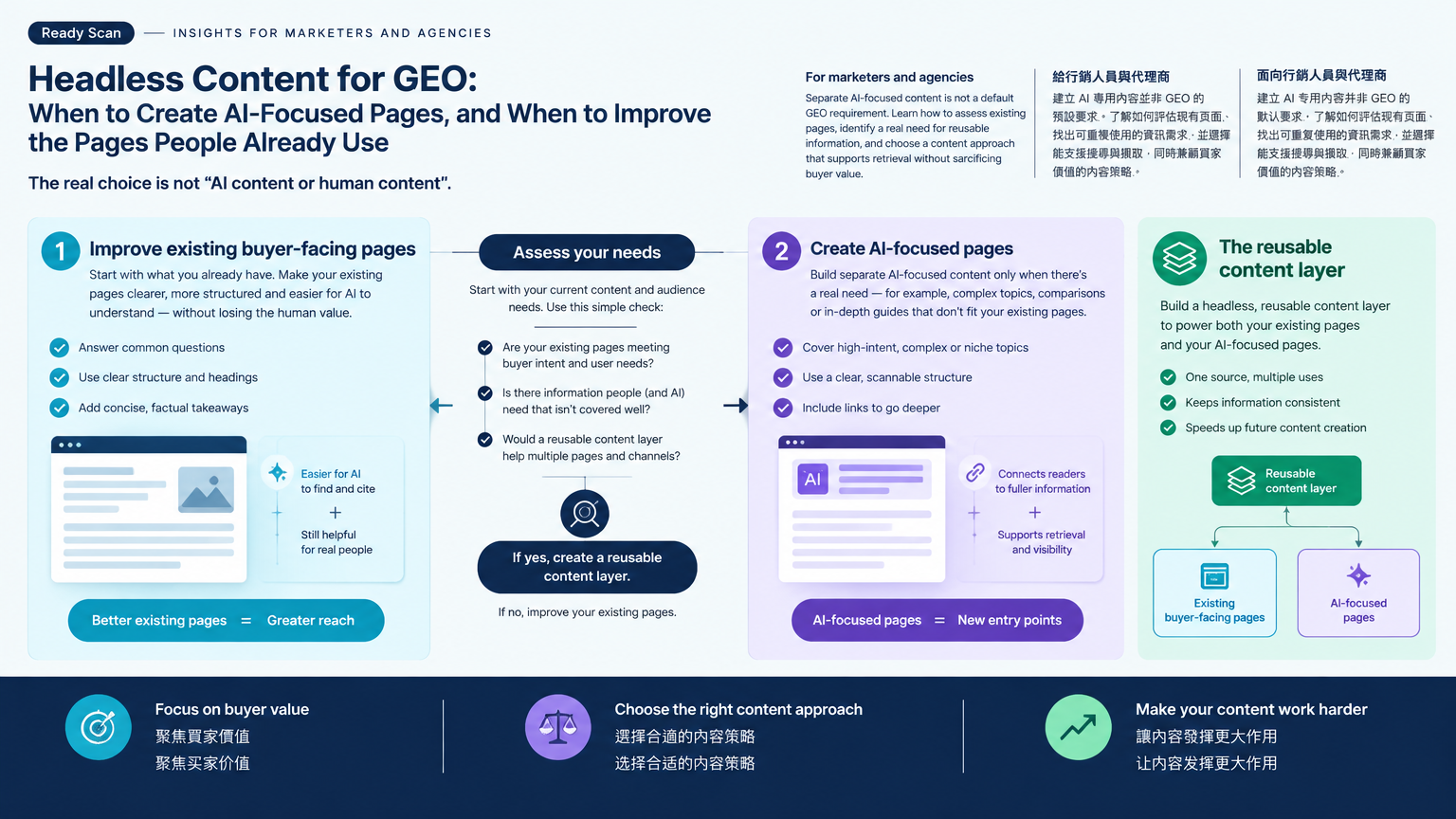
The real choice is not “AI content or human content”
For most campaigns, start by improving the page that already serves the buyer. Create a separate AI-focused public page only when it answers a distinct audience question; use a separate reusable content source when it solves a real publishing or governance need. The decision is about where useful information belongs, not whether to choose “AI content” or “human content.”
“Headless content marketing” describes pages created chiefly to provide information for retrieval and reuse in AI-generated answers, rather than to attract direct visits. It does not necessarily mean using a headless CMS: a headless CMS separates content management from presentation, while this label describes the intended use of the content, not a required publishing architecture. Pages in this approach tend to be concise and declarative, with specific references, supporting evidence, topic organization and regular updates. The idea is to make information available for systems to draw on, even when the reader may encounter it through an intermediary rather than by visiting the page.
That describes a strategy, not a proven visibility shortcut. Concise wording, frequent updates and a separate page do not guarantee that a system will retrieve, cite or recommend a brand. The useful question for a campaign is not whether a page looks “AI-ready.” It is whether the current content gives a buyer and a retrieval system accurate, accessible, well-organized information, and whether a separate publishing layer solves a real need that the existing site cannot handle well.
For most client work, that means starting with the pages people already use: service and product pages, comparison content, guides, FAQs, and evidence such as case studies or technical details. If those pages leave important questions unanswered, improving them may serve buyers and make the relevant information clearer to retrieve, without creating a parallel library. A separate layer earns consideration only when there is a distinct operational or product reason for it.
Sources: Headless Content Marketing: A New (Old) Strategy for Search; Google Search's guidance about AI-generated content
Audit the page against the buying decision
Before commissioning anything new, take one valuable buyer question and follow it through the content journey. A question such as “Which platform fits a growing team?” or “What does this agency actually manage?” is more useful than starting with an abstract AI-visibility topic. The goal is to find the point where the buyer cannot confidently understand, compare or act on the information.
Review the best existing destination and ask:
Is the answer easy to find? A useful conclusion buried beneath generic setup makes the page harder to use. Put the direct answer where it helps, then give readers the reasoning and context they need. As a quick editorial check, read only the opening sentence under each heading; together, they should make the page’s decision logic clear.
Is the offer or subject specific enough? Replace broad claims with relevant details: scope, conditions, audience fit, exclusions, differences between options, and what happens next.
Can the important claims be supported? Add appropriate evidence, such as documented product details, methodology, examples or case-study context. Do not make a claim more forceful than the support behind it.
Does the page help a person decide? Useful content includes trade-offs, limitations and practical implications, not just a compact definition that could fit many brands.
Can the information be found and maintained? Consider whether the page is accessible, clearly organized, linked from relevant parts of the site and assigned to an owner who can keep its facts current.
This separates different kinds of work that often get bundled together as “GEO optimization.” A missing answer may call for new copy. A weak or hard-to-find answer may call for editing and restructuring. A claim without support may need evidence or a more careful formulation. A useful answer that is difficult to reach may need better internal linking or access. Those are different fixes, and none automatically requires a new AI-focused URL.
Use the buyer’s task to determine the right depth. A factual product specification might need a concise, current statement. A buyer comparing agencies may need a fuller account of delivery scope, fit, evidence and trade-offs. Being direct helps both readers and systems, but directness does not mean stripping away the explanation that makes the answer useful.
Sources: What Is BLUF? How to Write Bottom Line Up Front (+ Free Rewriter Tool)
When a separate content layer earns its place
A separate layer can be useful, but it should solve a publishing problem, not simply satisfy a belief that AI prefers terse pages. One persuasive reason is that a business needs to maintain accurate, reusable facts across several destinations or channels. For example, product specifications, compatibility details, service-area information or current policy statements might need a controlled source that can feed a website, support materials and other approved experiences.
That is a content-management and governance case. It is not automatically a case for publishing a second set of public pages. The reusable source may sit in a structured content system and be presented in different formats, while the public product or service page remains the place where a buyer gets the fuller explanation. A separate public page makes sense only when it serves a distinct audience question or use case that cannot be handled clearly on the canonical page.
Before approving the approach, ask what will be true if the layer does not exist. Will teams repeat facts inconsistently? Is information being maintained in several places with no clear owner? Does a product or workflow genuinely require content to be reused in different contexts? If the answer is no, the proposed layer may be an added editorial burden rather than a solution.
Then make the operating model explicit:
Name the source of truth. Decide which system or page owns each fact, and how changes are approved.
Define what gets reused. Separate stable facts from context-dependent explanations, advice and claims that need a specific audience or qualification.
Set a human route to the fuller answer. If a concise reference page is useful, connect it to the relevant product, service or guide so a person can understand the implications and next step.
Assign update and review ownership. A frequently changing page is only valuable if someone can check its accuracy and retire stale information.
Count the total editorial cost. Include creating, checking, publishing, linking, reconciling and maintaining content across the layer and its destinations.
A well-managed reusable content source can improve consistency. A second library of near-duplicate pages can do the opposite: create conflicting facts, confuse page ownership, dilute a clear route for buyers and leave teams maintaining content that has no distinct job. The architecture should follow the actual reuse need, not the label “headless.”
Sources: Google Search's guidance about AI-generated content
Turn the decision into a focused client brief
A useful client brief should make the path from buyer need to content decision explicit. Before drafting, agree who owns the page, which source verifies the facts, and whether the work belongs on an existing destination or in a governed reusable source. Distinguish missing facts from editorial, evidence, access or governance issues; each calls for a different next action and may need a different owner.
Use information the client can substantiate, and confirm that the proposed answer serves a real audience need and campaign objective. If facts are unverified or ownership is unresolved, assign validation or governance work before commissioning copy. Then capture the decision in a short brief:
Buyer question: What is the person trying to understand, compare or do?
Current destination: Which existing page is meant to serve that need, and where does it fall short?
Verified gap: Is the issue missing information, weak evidence, unclear organization, difficult access or genuinely separate reusable data?
Recommended change: Improve the canonical page, add evidence, reorganize information, establish a reusable source, create a distinct page, or make no change.
Reader path: How will someone reach the full explanation or take a sensible next step?
Owner and upkeep: Who approves the facts and maintains them?
Review signal: What will the team observe after the change, and which business outcome will be assessed separately?
This format also makes “do not create a page” a defensible recommendation. If the need is already served, a near-duplicate would add maintenance without giving the buyer a better answer. If the gap is unclear, investigate before committing production time. If a genuinely distinct question has no appropriate home, define its purpose and audience before creating a separate destination.
Measure the work without promising citations
A credible GEO recommendation connects a content change to a buyer need and an agreed review, without pretending that a citation is a business outcome. Before making the change, record a baseline for the relevant buyer questions and the page’s business role. Keep the observation, interpretation and decision distinct:
Observation: A page was cited, a brand was mentioned, a referral arrived, or none of those appeared in a given check. Record the question, platform, date, relevant settings, complete answer and cited URL where available. This gives the team context to compare later checks.
Interpretation: The page may be helping with a particular audience question, or its information may be unclear or incomplete. This is a working explanation, not proof of what caused an answer.
Decision: Improve a defined page, add substantiated information, maintain a reusable source, monitor the issue, or leave it alone.
After the change, revisit the same questions and, where practical, keep the platform and comparison context consistent. Note changes in the AI system, question wording or setup rather than treating unlike checks as a direct comparison. Review the page’s business role against an agreed measure, such as whether it better explains fit, scope or evidence to buyers. Assess relevant analytics and CRM outcomes separately. A citation or recommendation may be worth tracking, but it does not prove that a buyer visited, converted or generated revenue. Likewise, absence from one answer is not a diagnosis that the whole content strategy is failing.
For client reporting, show what was changed and why, which question it serves, who owns ongoing accuracy, and when the team will review it. If the intervention was a reusable content source, check whether approved facts are easier to keep consistent across the intended destinations. These are meaningful outcomes even when AI visibility is variable or not directly observable.
The right GEO move is the one that closes a real information gap in a maintainable way. Start with the buyer’s question, make the existing page do its job if it can, and separate content only when a genuine reuse or audience need justifies the extra layer. That gives marketers a stronger client conversation than “we need pages for AI”: a clear choice, a defensible rationale and a next step tied to useful information.
Sources: Headless Content Marketing: A New (Old) Strategy for Search; What Is BLUF? How to Write Bottom Line Up Front (+ Free Rewriter Tool); Google Search's guidance about AI-generated content
Sources
- Headless Content Marketing: A New (Old) Strategy for SearchAhrefs · Accessed Explore publications using this source
- What Is BLUF? How to Write Bottom Line Up Front (+ Free Rewriter Tool)Ahrefs · Accessed Explore publications using this source
- Google Search's guidance about AI-generated contentGoogle Search Central · Accessed Explore publications using this source