
Public observation context
Original report · Exact report snapshot
- Product
- KKday
- Observation language
- en-US
- Region
- Hong Kong
- Buyer questions
- 4
- Recorded narrative answers
- 12
- Completed narrative answers
- 12
- Supporting searches
- 4
- Full narrative observation period (UTC)
- 2026-10-20T03:25:34.401Z — 2026-10-20T03:26:42.836Z
- Narrative count by date (UTC)
- 2026-10-20: 12
- Report generated
- 2026-10-20T04:02:30.360Z
- Website source captured
- 2026-10-20T03:34:13.895Z
- Narrative models
- chatgpt: openai/gpt-6-luna; claude: anthropic/claude-haiku-5.5; gemini: google/gemini-3.7-flash
Original observation witnesses
Public observation context
Original report · Exact report snapshot
- Product
- Wing On Travel
- Observation language
- en-US
- Region
- Hong Kong
- Buyer questions
- 4
- Recorded narrative answers
- 12
- Completed narrative answers
- 12
- Supporting searches
- 4
- Full narrative observation period (UTC)
- 2026-10-20T03:25:34.401Z — 2026-10-20T03:26:42.836Z
- Narrative count by date (UTC)
- 2026-10-20: 12
- Report generated
- 2026-10-20T03:34:13.916Z
- Website source captured
- 2026-10-20T03:31:17.809Z
- Narrative models
- chatgpt: openai/gpt-6-luna; claude: anthropic/claude-haiku-5.5; gemini: google/gemini-3.7-flash
Original observation witnesses
Public observation context
Original report · Exact report snapshot
- Product
- Klook
- Observation language
- en-US
- Region
- Hong Kong
- Buyer questions
- 4
- Recorded narrative answers
- 12
- Completed narrative answers
- 12
- Supporting searches
- 4
- Full narrative observation period (UTC)
- 2026-10-20T03:25:34.401Z — 2026-10-20T03:26:42.836Z
- Narrative count by date (UTC)
- 2026-10-20: 12
- Report generated
- 2026-10-20T03:35:45.010Z
- Website source captured
- 2026-10-20T03:32:47.439Z
- Narrative models
- claude: anthropic/claude-haiku-5.5; chatgpt: openai/gpt-6-luna; gemini: google/gemini-3.7-flash
Original observation witnesses
Public observation context
Original report · Exact report snapshot
- Product
- Expedia
- Observation language
- en-US
- Region
- Hong Kong
- Buyer questions
- 4
- Recorded narrative answers
- 12
- Completed narrative answers
- 12
- Supporting searches
- 4
- Full narrative observation period (UTC)
- 2026-10-20T03:25:34.401Z — 2026-10-20T03:26:42.836Z
- Narrative count by date (UTC)
- 2026-10-20: 12
- Report generated
- 2026-10-20T03:33:29.619Z
- Website source captured
- 2026-10-20T03:30:33.911Z
- Narrative models
- claude: anthropic/claude-haiku-5.5; chatgpt: openai/gpt-6-luna; gemini: google/gemini-3.7-flash
Original observation witnesses
Public observation context
Original report · Exact report snapshot
- Product
- hutchgo
- Observation language
- en-US
- Region
- Hong Kong
- Buyer questions
- 4
- Recorded narrative answers
- 12
- Completed narrative answers
- 12
- Supporting searches
- 4
- Full narrative observation period (UTC)
- 2026-10-20T03:25:34.401Z — 2026-10-20T03:26:42.836Z
- Narrative count by date (UTC)
- 2026-10-20: 12
- Report generated
- 2026-10-20T03:37:47.227Z
- Website source captured
- 2026-10-20T03:34:37.439Z
- Narrative models
- chatgpt: openai/gpt-6-luna; claude: anthropic/claude-haiku-5.5; gemini: google/gemini-3.7-flash
Original observation witnesses
Public observation context
Original report · Exact report snapshot
- Product
- Hotels.com
- Observation language
- en-US
- Region
- Hong Kong
- Buyer questions
- 4
- Recorded narrative answers
- 12
- Completed narrative answers
- 12
- Supporting searches
- 4
- Full narrative observation period (UTC)
- 2026-10-20T03:25:34.401Z — 2026-10-20T03:26:42.836Z
- Narrative count by date (UTC)
- 2026-10-20: 12
- Report generated
- 2026-10-20T03:33:47.928Z
- Website source captured
- 2026-10-20T03:30:51.910Z
- Narrative models
- claude: anthropic/claude-haiku-5.5; chatgpt: openai/gpt-6-luna; gemini: google/gemini-3.7-flash
Original observation witnesses
Public observation context
Original report · Exact report snapshot
- Product
- Rakuten Travel
- Observation language
- en-US
- Region
- Hong Kong
- Buyer questions
- 4
- Recorded narrative answers
- 12
- Completed narrative answers
- 12
- Supporting searches
- 4
- Full narrative observation period (UTC)
- 2026-10-20T03:25:34.401Z — 2026-10-20T03:26:42.836Z
- Narrative count by date (UTC)
- 2026-10-20: 12
- Report generated
- 2026-10-20T03:38:10.129Z
- Website source captured
- 2026-10-20T03:34:59.791Z
- Narrative models
- chatgpt: openai/gpt-6-luna; claude: anthropic/claude-haiku-5.5; gemini: google/gemini-3.7-flash
Original observation witnesses
A name in the answer is only the starting point
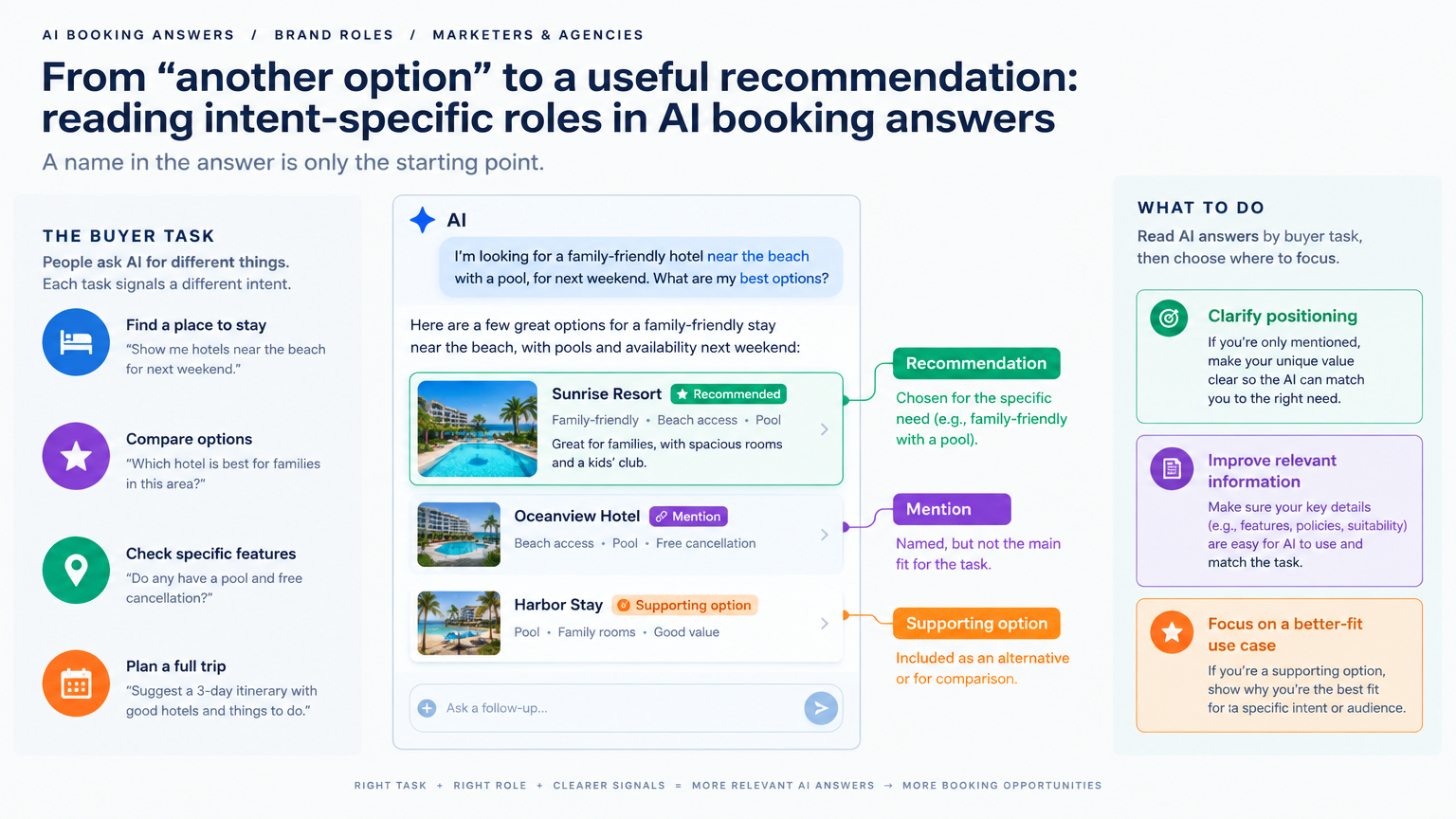
When an AI answer names your brand but puts other options first, it is tempting to call the result a visibility problem. That may be too blunt. The brand might be a strong fit for one part of the buyer’s decision, a useful alternative under a particular condition, or simply one item in a list. Those roles carry different commercial value and call for different next steps.
A mention answers: does the brand appear at all? A recommendation asks more: does the answer connect the brand to the need, and explain why a buyer should consider it? A supporting alternative can be relevant without being the default choice. For example, the answer might include a platform as an extra price check, a possible package option, or a place to compare cancellation terms. A mention alone does not tell you which of these is happening.
That distinction matters in client reporting. If the target is a price-conscious traveler, appearing only in a broad list may be less meaningful than being recommended for the specific booking task. Conversely, a brand need not be first in every answer to be commercially relevant. A useful diagnosis starts with the buyer’s job, not a league table of brand names.
A Ready Scan snapshot captured on 20 October 2026 looked at answers to Hong Kong travel-booking questions for Expedia and Hotels.com. Expedia appeared in nine of twelve retained answers and was recommended in seven. Those totals are a useful orientation, but they compress four quite different buyer tasks. Reading the answers task by task reveals a more actionable story. These are answer-level observations from a snapshot, not evidence of subsequent gains or of why a model chose a particular role.
Sources: Expedia: public GEO observations; Hotels.com: public GEO observations
The task changes the role: four travel questions, four different readings
The snapshot covered hotel price comparison, a budget-conscious Osaka stay, family-room occupancy, and flexible cancellation. Expedia’s place in the answers shifted with the task. That is the useful comparison: not “Is Expedia visible overall?” but “For which buyer job does it become a recommendation, and when is it only a supporting option?”
| Buyer task in the snapshot | Expedia’s observed role | What a marketer can reasonably take from it |
|---|---|---|
| Compare Japan hotel prices, cancellation terms and payment | Appeared in two of three answers. One suggested it as an extra price check; another included it among providers listed by a metasearch service. | Presence did not consistently translate into a direct recommendation for this comparison task. |
| Find an Osaka stay around HK$1,000 per night | Appeared in all three answers as a possible option, including for comparing a flight-and-hotel package. One answer noted that a standalone hotel price might not be cheaper. | The package use case gave the brand a more specific job than a generic hotel-search mention, but the answers still framed it conditionally. |
| Find a Japan family room and check occupancy | Absent from two retained answers. In the third, appeared as an example of a platform allowing a particular five-person booking in one cited comparison. | This was an incidental example, not a recommendation for families. It is a different kind of evidence from a product-fit endorsement. |
| Find a hotel with flexible cancellation | Appeared in all three answers, grouped with alternatives to compare. | It was a relevant comparison option, but the answer made the chosen rate’s cancellation rules, not the platform name, central to the decision. |
This reading also explains how a single aggregate can mislead. Expedia’s observed recommendation rate was high for the Osaka budget and cancellation questions, weaker for price comparison, and low for the family-room task. The family-room answer that named Expedia did so in a narrow example, not as a family-travel recommendation. Counting it as equivalent to the package recommendation would overstate its strength for that audience.
Hotels.com makes the same point from another angle. In its separate snapshot, it appeared in four of twelve answers: once in a Japan price-comparison answer, once as an additional comparison option for Osaka, and in two cancellation answers as an option alongside Expedia. It did not appear in the retained family-room answers. That pattern is not a controlled head-to-head comparison with Expedia: the prompts and retained answers are snapshots, and the question wording differs. It is still useful as a reminder that adjacent brands can be assigned similar supporting roles, while their answer-level presence varies by task.
The answer sets do not establish why a model assigned a role. They do show what a marketer can inspect: how the question frames the decision, what job the brand is given, which alternatives accompany it, and what conditions qualify the suggestion.
Sources: Expedia: public GEO observations; Hotels.com: public GEO observations; Wing On Travel: public GEO observations; Klook: public GEO observations; Wing On Travel: public website context; Klook: public website context; hutchgo: public website context; hutchgo: public GEO observations; Rakuten Travel: public GEO observations; Rakuten Travel: public website context; KKday: public GEO observations; KKday: public website context
Separate what the answer says from what the brand says about itself
A brand’s public site can help explain whether a task-specific role makes sense. It cannot tell you, by itself, what information an AI answer relied on. Keep those two evidence streams separate in analysis and in client-facing slides.
For example, Expedia’s Hong Kong site presents hotel search, flight add-ons, child-age and room inputs, a statement about free cancellation on most hotels, and a route for bookings of nine or more rooms. Hotels.com’s Hong Kong site presents child-age and room inputs, member savings, reward nights, a statement about free cancellation on thousands of hotels, and a route for bookings of nine or more rooms. These are useful positioning cues from the companies’ own sites. They may help a marketing team identify customer use cases to describe more clearly. They do not establish that an AI answer saw those pages or based a recommendation on them.
That separation is commercially important. If answers frame Expedia as an extra price check or a possible package option, the question for marketers is not simply whether to repeat “hotel booking” more often. It is whether the company wants to own a more precise customer job, such as comparing a hotel-only stay with a flight-and-hotel package, and whether its public information explains that job in buyer language. If the desired job is family travel, generic family-oriented search fields are not the same thing as clear evidence about family-room fit, occupancy, beds, or children’s policies.
The same discipline applies to cancellation. A site-wide statement about cancellation availability does not mean every hotel or rate is cancellable. In the observed answers, cancellation decisions centered on the specific room or rate’s terms. A useful brand proposition therefore needs to describe what buyers can check or compare, while avoiding an absolute promise where the offer depends on the selected property and rate.
Sources: Expedia: public website context; Hotels.com: public website context; Expedia: public GEO observations; Hotels.com: public GEO observations; Wing On Travel: public GEO observations; Klook: public GEO observations; Wing On Travel: public website context; Klook: public website context; hutchgo: public website context; hutchgo: public GEO observations; Rakuten Travel: public GEO observations; Rakuten Travel: public website context; KKday: public GEO observations; KKday: public website context
Turn an answer role into a focused positioning decision
A practical response is to map each priority buyer task against the role you want the brand to play and the proof a buyer needs to make that role credible. This keeps content work connected to positioning, rather than turning every weak-looking mention into a site-wide rewrite.
For a booking brand, imagine a team prioritizing three needs: low-friction price comparison, a flight-and-hotel package, and family-room planning. The snapshot suggests different questions for each. For comparison, can a traveler readily understand how to compare a hotel-only price with alternatives and what matters beyond the headline rate? For a package, is the combined trip value easy to understand alongside the option to book separately? For family travel, do the pages make occupancy, child ages, beds, and room arrangements clear enough to support the actual booking decision? These are positioning and information questions to investigate, not conclusions that the snapshot proves a gap exists.
A useful working matrix might look like this:
| Buyer task | Desired role | Evidence to make the role useful | Possible next action |
|---|---|---|---|
| Compare hotel prices | A credible option for a like-for-like comparison | Clear explanation of what is being compared and relevant booking details | Clarify the comparison use case and the information available before booking |
| Combine travel components | A relevant package option when the traveler is still planning the trip | A straightforward explanation of how to assess a package against separate bookings | Make the package use case more explicit in relevant public information |
| Book for a family | An option that helps a family assess room fit | Specific, accurate room, occupancy and child-policy details where available | Improve or organize family-relevant details; route unresolved policy questions to the property |
| Keep plans flexible | An option worth comparing for the selected rate | The actual cancellation deadline and conditions for that rate | Make rate-level terms easy to find and avoid implying every rate is flexible |
The matrix is not a promise that publishing a page will change an AI answer. It is a way to translate an observed answer role into work that can help a real customer, whether or not the AI system changes its wording.
Before commissioning content, check the customer journey and the information the business can stand behind. Is there already a page that answers the task but is hard to find? Is an important distinction missing from the booking flow? Does the brand actually offer the use case the team wants to emphasize? A new page is useful only when it adds clear, accurate information instead of restating a generic brand promise.
Sources: Expedia: public GEO observations; Expedia: public website context; Hotels.com: public GEO observations; Hotels.com: public website context; Wing On Travel: public GEO observations; Klook: public GEO observations; Wing On Travel: public website context; Klook: public website context; hutchgo: public website context; hutchgo: public GEO observations; Rakuten Travel: public GEO observations; Rakuten Travel: public website context; KKday: public GEO observations; KKday: public website context
Make the reporting useful for the next decision
For marketers and agencies, useful reporting does more than count favorable mentions. It connects a commercially important buyer task to the role the brand plays in answers, the strength of its offer fit, and what the team can actually change. Agree the decision the report should support, such as campaign planning, client positioning or a content brief. Then prioritize tasks by business importance, offer fit, observed answer role and how much control the team has over the relevant information or customer experience. Low visibility alone is not a content brief.
To make the next decision explicit, give each finding a disposition:
Act now: A specific, accurate product fact or customer-facing information gap needs attention.
Validate first: The offer fit or underlying information is unclear, or the answer’s suggestion is conditional or incidental.
Monitor: The task matters, but no concrete change is yet within the team’s control.
No action: The buyer’s need is outside the offer, or an isolated variation does not justify work.
Record the reason and an owner for each disposition. This helps the team avoid turning every absence into a content assignment, and gives client teams a clear next step.
A practical reporting note can capture, for each task:
The buyer question: Keep the original wording, region and relevant setup. “Japan hotel comparison” is too broad if the question is actually about cancellation and payment as well as price.
The answer’s role: Record whether the brand was absent, mentioned, conditionally recommended, directly recommended, or cited without being named. Include a short excerpt that shows the role; do not rely only on an automated label.
The comparison set: Note which alternatives appeared and how they were framed. A brand grouped with competitors as an extra comparison has a different role from one given a clear reason to choose it.
The proposed action and owner: Link the role to a real page, product fact or customer decision the business can address. If no specific gap is visible, record that rather than inventing a content task.
The next review: Revisit the same buyer task and retain the complete answer. Keep changes to the prompt, model or setup distinct from like-for-like observations. When a decision depends on a pattern, repeat the check rather than treating one output as conclusive.
Use a visibility score as a navigation aid, not as the strategy. In this snapshot, the family-room results point to a narrower opportunity than the cancellation results. If family travel is commercially important and supported by the offer, check whether accurate, room-specific details are available and easy to understand. If the brand’s strongest credible role is package comparison, explaining that use case may be a better fit than trying to look like a universal leader in hotel-only pricing.
Finally, keep visibility separate from performance. A mention or recommendation is not evidence of a booking, referral or revenue contribution. When business impact matters, review relevant referral and conversion data separately. Intent-specific reporting makes the next decision more precise: not “How do we get named more?”, but “For which customer task do we want to be a useful recommendation, and what can we credibly do to earn that role?”
Sources: Expedia: public GEO observations; Hotels.com: public GEO observations; Wing On Travel: public GEO observations; Klook: public GEO observations; Wing On Travel: public website context; Klook: public website context; KKday: public GEO observations; KKday: public website context
Sources
- Expedia: public GEO observationsReady Scan · Accessed Explore publications using this source
- Expedia: public website contextwww.expedia.com.hk · Accessed Explore publications using this source
- Hotels.com: public GEO observationsReady Scan · Accessed Explore publications using this source
- Hotels.com: public website contextzh.hotels.com · Accessed Explore publications using this source
- Wing On Travel: public GEO observationsReady Scan · Accessed Explore publications using this source
- Klook: public GEO observationsReady Scan · Accessed Explore publications using this source
- Wing On Travel: public website contextwww.wingontravel.com · Accessed Explore publications using this source
- Klook: public website contextwww.klook.com · Accessed Explore publications using this source
- hutchgo: public website contextwww.hutchgo.com.hk · Accessed Explore publications using this source
- hutchgo: public GEO observationsReady Scan · Accessed Explore publications using this source
- Rakuten Travel: public GEO observationsReady Scan · Accessed Explore publications using this source
- Rakuten Travel: public website contexttravel.rakuten.com · Accessed Explore publications using this source
- KKday: public GEO observationsReady Scan · Accessed Explore publications using this source
- KKday: public website contextwww.kkday.com · Accessed Explore publications using this source