
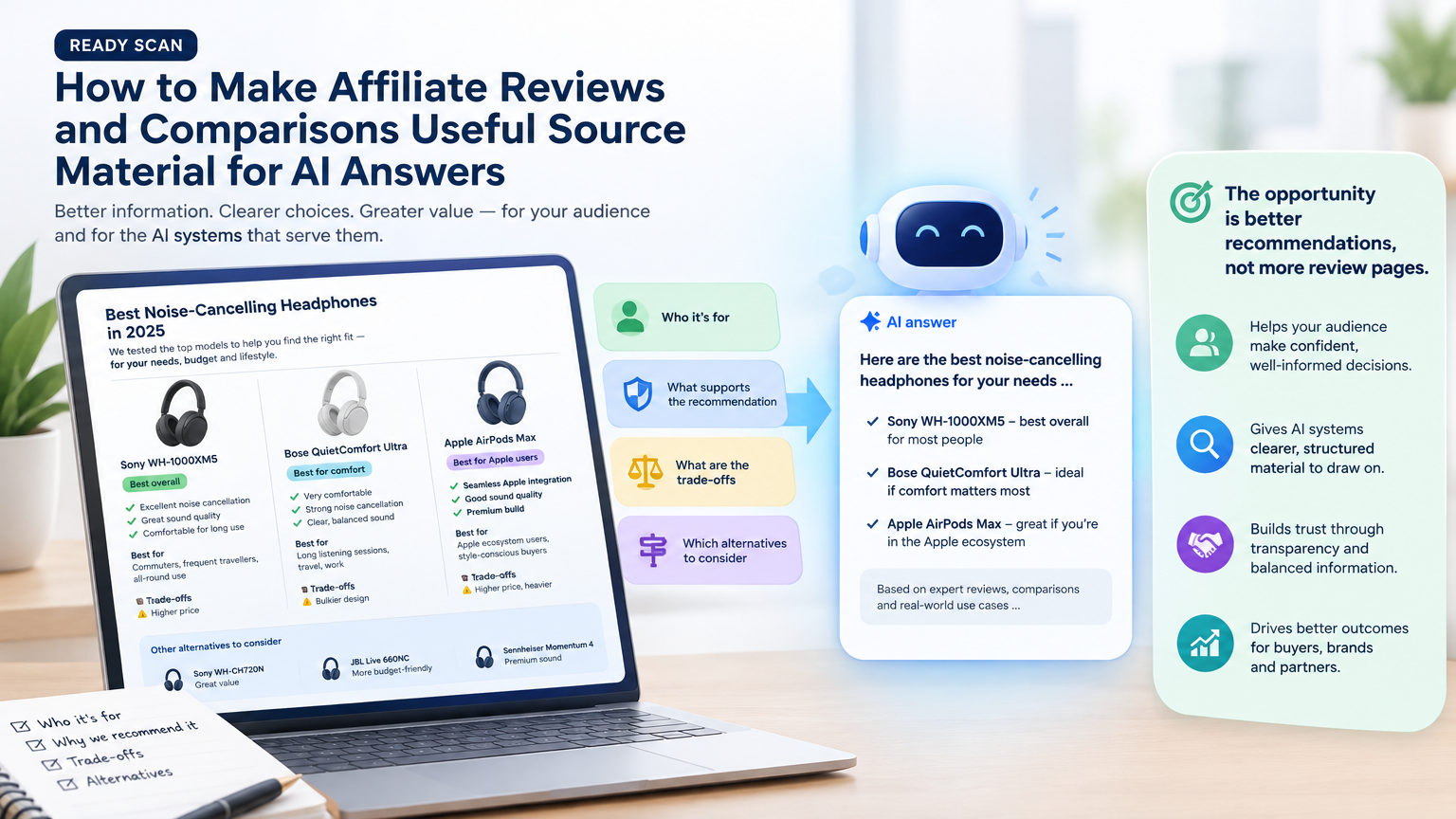
The opportunity is better recommendations, not more review pages
AI assistants may draw recommendations from reviews, comparisons and test results, and may cite pages they use. That gives affiliate publishers a reason to make their best buying guides more useful. It is an opportunity, not a placement promise: no particular format, affiliate link or review page is guaranteed to appear in an answer.
The commercial point is equally important. A citation is not a sale, and a brand mention is not necessarily a recommendation. An answer might name a product without endorsing it, cite a page for one detail, or suggest an option for a particular buyer. Each is a different visibility signal, and none alone proves that a reader clicked, bought or generated commission.
So the working question is not, “How do we add affiliate links to more pages?” It is, “What can a buyer learn here that helps them choose between real options?” A page that answers that well has a clear reason to exist for the reader, whether or not an AI system later draws on it. That is a stronger editorial and commercial foundation than producing another page that paraphrases a merchant’s description.
Sources: Affiliate Marketing: What It Is & How to Start in 2026
Give every recommendation a buyer and a reason
“Best” is not a useful conclusion until the reader knows best for whom and for what. A buyer looking for a low-cost starter option may value something different from a frequent user who prioritizes durability. Start by naming the need and the conditions that shape it, then make the recommendation specific to that decision.
A useful review or comparison should make these points easy to find:
Who is this for? Describe the buyer, use case or constraint that makes the option a good fit.
Why this option? State the reasons for recommending it and the evidence behind those reasons.
What matters in this category? Explain the criteria that affect the buying decision, rather than treating every specification as equally important.
What are the meaningful alternatives? Compare the options a sensible buyer would actually consider, not an arbitrary list of products.
What is the trade-off? Say where the recommendation is weaker, less suitable or more limited.
What should the buyer verify? Make relevant conditions, availability or product-version details clear, especially when they could change the decision.
The parts work together. An alternative is meaningful when it serves a different need; a drawback is helpful when the reader can use it to decide. A comparison table can make differences scannable, but it cannot supply the editorial judgment. Explain why those differences matter to the intended buyer, and make the recommendation’s boundaries as visible as its strengths.
Sources: Affiliate Marketing: What It Is & How to Start in 2026
Make the evidence match the claim
The most useful distinction in review work is not between “tested” and “untested” as labels. It is between what the publisher actually knows and what the page claims. A recommendation can be valuable without a hands-on test, but the basis for it should be clear. If you did not test or use a product, do not imply that you did.
A publisher’s contribution might come from actual product use, a documented comparison, accumulated category data, relevant expert input or careful analysis of available information. These are not interchangeable forms of evidence. State what was done, what information was reviewed and what the evidence can reasonably support. If the recommendation relies on specifications or public materials, present it as an assessment of that information, not as a firsthand verdict.
For hands-on work, describe the process in a way that helps a reader understand the result: what was used or measured, in what conditions, over what period, and how products were compared. A vague phrase such as “extensively tested” gives the reader little to evaluate. Specific details help explain why the finding matters and where it may not apply.
Accumulated data can also make a comparison more useful than a row of individual summaries. Depending on the category, a publisher might consistently track prices, specifications, compatibility, reported service experiences or reader-submitted outcomes. The value comes from a clear collection method, useful coverage and careful limits, not from presenting a large spreadsheet without context. Relevant experts can add another perspective, provided their role and input are represented accurately.
AI tools can support the maintenance work around a review, for example by flagging possible price or feature changes or organizing source material for an update. Treat those flags as prompts to check, not as verified facts. Confirm changes against current, relevant information before updating a claim. AI cannot provide firsthand testing that did not happen or replace editorial judgment about what the evidence supports.
An illustrative edit shows the difference. Instead of an unsupported claim that a product is “best,” a page might say it suits a particular buyer, explain the evidence behind that judgment, name a relevant drawback and compare it with a plausible alternative. That example describes a better editorial practice, not a tested result or a promise of increased AI visibility.
Sources: Affiliate Marketing: What It Is & How to Start in 2026
Build a comparison that earns its place
A comparison page should help a buyer make a decision, not merely provide a convenient home for merchant links. Start with a real choice the reader faces. Are they choosing between two products, deciding whether a more expensive option is worth it, or trying to find the right fit for a specific use? The answer determines which products belong in the comparison and which criteria deserve attention.
Then make the page’s logic visible. Explain why these options were selected, what you compared, and which differences matter for the intended buyer. Keep claims close to their supporting evidence. If products were assessed in different ways, disclose that rather than implying a controlled, like-for-like test. If a comparison uses public specifications, make clear where the conclusion depends on those specifications and where the buyer may need to verify current details.
A useful page flow might include:
A clear decision and audience: state who the comparison is for and what choice it helps them make.
A concise recommendation with conditions: identify the strongest fit for a defined need, not a universal winner.
Evidence and comparison criteria: explain how the assessment was made and what information supports it.
Alternatives and trade-offs: show when another product may be the better choice and why.
A practical next step: help the reader check a relevant detail, compare the options or visit a merchant after they have enough information.
This is an adaptable editorial sequence, not a required review template. A short comparison may need only a few of these elements; a complex purchase may need deeper explanation or a maintained dataset. What matters is that a buyer can follow the reasoning instead of having to infer why one product won.
Affiliate economics can create pressure to foreground products with stronger commissions. Keep that commercial incentive from quietly deciding the editorial ranking. Choose and explain recommendations on their fit for the reader. Disclose affiliate relationships clearly and in a place readers can see before acting. Disclosure supports trust and may be a compliance requirement, but it does not guarantee an AI mention, citation, referral or commission.
Sources: Affiliate Marketing: What It Is & How to Start in 2026
Audit priority pages for decision value
For an affiliate publisher or an agency managing a client’s commerce content, begin with a small set of high-priority comparisons. You do not need to audit every product URL at once. Select pages that matter to the business and where the reader is likely to be choosing between real options. Give priority to pages where a clearer, better-supported recommendation could help a buyer make that choice, rather than selecting pages solely because a brand did not appear in an AI answer.
For each page, ask:
Can a reader tell who the recommendation is for and what need it addresses?
Is each material claim supported by actual testing, documented use, relevant expertise or identifiable information?
Does the page say what the evidence does and does not establish?
Are the alternatives meaningful to this buyer, rather than present just to fill out a list?
Are limitations, drawbacks and conditions clear enough to affect a decision?
Does the page distinguish the publisher’s assessment from the merchant’s own product claims?
Are product details current enough for the page’s purpose, and is there a clear owner or process for updates?
Is the affiliate relationship disclosed clearly?
A “no” is a prompt to investigate and improve, not an instruction to add copy automatically. Identify the kind of gap before choosing a fix: a claim may need stronger evidence, the products may not serve the same need, an important detail may be hard to find, or product information may need checking. Address the gap with the change that best helps the buyer. Gather evidence or narrow a claim when support is missing; narrow the comparison when the options do not fit the same decision; make existing details easier to find when the information is already there. If the page needs no meaningful change, leave it alone. This keeps the audit focused on decision value rather than word count or an AI visibility signal by itself.
Sources: Affiliate Marketing: What It Is & How to Start in 2026
Measure visibility without mistaking it for revenue
Use AI-answer observations to understand how your content is being used, not as a stand-in for affiliate performance. When reviewing answers, keep the complete wording and any source references. Distinguish among a brand mention, a source citation and an actual recommendation. Check what the cited page supports and whether the recommendation is tied to a buyer need. A citation alone does not prove that the page caused the recommendation.
Keep the commercial funnel separate. Track attributable visits, affiliate-link clicks and reported commissions through the systems available to you. A citation may be useful exposure even when it does not produce an immediate visit; a visit does not guarantee a sale. The merchant controls the purchase experience and affiliate-program terms, so downstream performance cannot be inferred from the answer itself.
For an agency or publisher team, turn an audit into a manageable editorial brief: the buyer question, the page, the evidence gap, the change to make, the person responsible and a review point. Agree what success means for that work. It may be a more accurate recommendation, clearer product fit, a better-supported comparison or improved engagement from readers. AI mentions and citations can be included as observations, but do not present them as proof that a content change produced traffic, commission or revenue.
The best next step is usually a focused one: improve the recommendation that matters most to a buyer, substantiate the claims you make and make the trade-offs easy to understand. Treat affiliate content as part of a broader audience strategy, not a bet on one discovery channel. Where it fits how your buyers research, give them a reason to return through a newsletter, video or another channel you can maintain, and assess those efforts separately from AI mentions, referrals and commissions. Do that before expanding the page count. AI systems may change what they retrieve or cite, but a clear, honest comparison remains useful to the people making the purchase decision.
Sources: Affiliate Marketing: What It Is & How to Start in 2026