
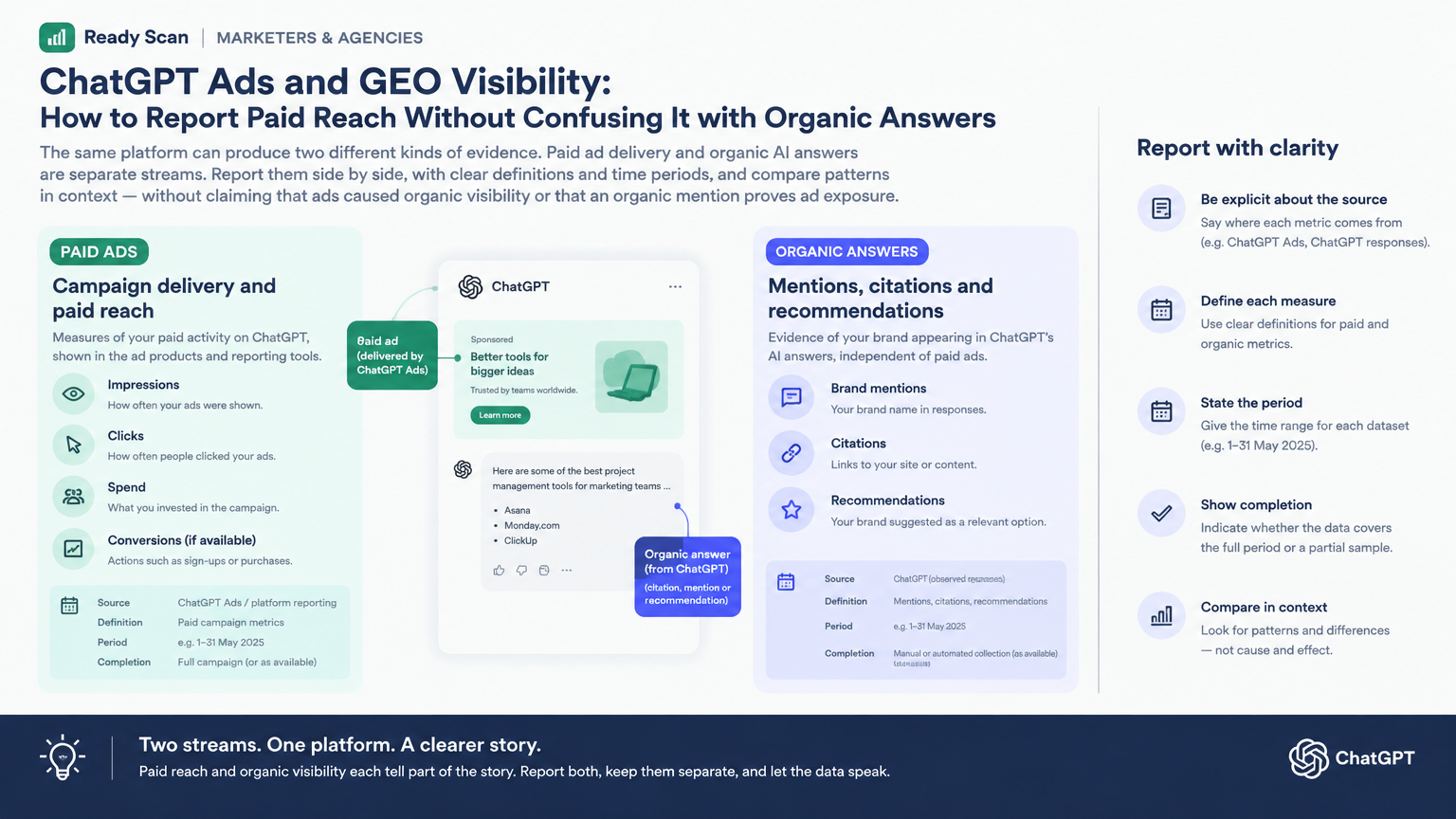
The same platform can produce two different kinds of evidence
When a client asks whether a brand is “showing up in ChatGPT,” they may mean two quite different things. They may be asking whether the brand’s paid campaign delivered an ad to people using ChatGPT. Or they may be asking whether an answer introduced, mentioned, cited or recommended the brand without that observation being an ad impression. The platform is shared; the evidence is not.
That distinction is the foundation of a credible report. Paid campaign reporting describes ad delivery and any separately defined reach measures. GEO visibility describes what a defined set of AI answers says about a brand, and whether those answers cite relevant sources. One can be reported beside the other, but neither is a proxy for the other.
A branded AI experience is another route worth distinguishing. OpenAI’s Radisson case describes a branded hotel-discovery experience in ChatGPT alongside sponsored ads, with separate results for each route. OpenAI reports early plugin visit-to-booking conversion at approximately 1.5 times Radisson’s organic search for July–August 2026. It also reports that 54% of recorded checkout and booking events from Radisson’s sponsored-ad campaigns were attributed to ad views through view-through measurement. These are company-reported results for Radisson’s specific experience and measurement approach, not general benchmarks, evidence that ads changed general ChatGPT answers, or proof that organic answer visibility caused bookings. If a client has a comparable experience, report its customer journey and outcomes separately from ad delivery and observations of general AI answers.
OpenAI’s October 21, 2026 announcement said ChatGPT Ads were expanding to 26 additional countries, bringing availability to 89 countries, and that more than 100,000 advertisers had run campaigns since launch. These are OpenAI-reported platform figures. They describe the company’s reported expansion and advertiser uptake, not independently measured campaign reach, performance or business results for a particular advertiser.
The same announcement says ads appear only on Free and Go plans, are clearly labeled and separate from ChatGPT answers, and do not influence the answers ChatGPT provides. For marketers, that separation has a direct reporting implication: an ad delivery record is not evidence of organic answer visibility, and an organic answer mentioning a brand is not evidence that an ad was delivered. Keep the two claims distinct even when they appear in the same client presentation.
There is also a practical availability question. The announcement does not establish that ChatGPT Ads are available in Hong Kong. Before presenting an activation plan as available in a market, check current platform access and buying arrangements. A regional expansion figure is not, by itself, confirmation of availability in every market a client serves.
Sources: ChatGPT Ads expands to 26 new countries as over 100,000 advertisers have used the platform | OpenAI; Radisson Hotel Group brings hotel discovery into ChatGPT | OpenAI; Building advertising for the way people use AI | OpenAI; Liste des robots d'exploration communs de Google
Give each evidence stream its own job in the report
Start the report by agreeing what decision it should support: assess paid delivery, review how the brand appears in selected buyer-question answers, or identify what further outcome tracking is needed. Set the scope before interpreting any movement.
For paid activity, use the advertising platform’s own metric names and definitions. OpenAI’s October 5 announcement describes measurement tools and partner integrations, including conversion-data sharing and web or app attribution options such as click attribution. It also says incrementality work is at an early stage, including exploration of geo-based experiments. These are platform-described options, not a complete framework or proof of an advertiser’s results. Confirm what is available for the campaign and market you are reporting. The October 21 announcement says more formats, objectives, buying options and measurement capabilities are in development.
For organic visibility, keep each observation reviewable: retain the exact buyer question, language and market context; the AI experience and material settings; the observation date; whether an answer was obtained; and the answer or relevant evidence. Classify what the answer actually does. A brand name is a mention; a source reference is a citation; a recommendation requires wording that suggests the brand or product for a need, sometimes with conditions or alternatives.
When reporting a rate, show its numerator and denominator among completed observations, and show completion separately against the planned set. A failed or missing answer is unknown, not evidence of brand absence. Keep the question wording and material settings stable across periods, or flag changes before comparing results.
| Reporting element | Paid campaign | Organic answer observations |
|---|---|---|
| What it describes | Ad delivery or other available campaign measures. | What a defined set of AI answers says and which sources it cites. |
| Data source | The advertising platform’s campaign reporting. | Saved answer observations and their collection records. |
| Scope to state | Campaign, market and reporting period. | Questions, AI experience, settings, language and observation period. |
| Useful interpretation | What the campaign reporting says about paid activity. | Whether observed answers mention, cite or recommend the brand. |
| What it does not prove on its own | Organic answer visibility or the content of an answer. | Ad exposure, campaign delivery or an ad-driven visit. |
Use the table as a compact reporting specification. In the client deck, keep the two evidence streams separately labelled and sourced; avoid combining them into a headline or total that suggests they are one measure.
Sources: ChatGPT Ads expands to 26 new countries as over 100,000 advertisers have used the platform | OpenAI; Radisson Hotel Group brings hotel discovery into ChatGPT | OpenAI; Building advertising for the way people use AI | OpenAI
Compare the signals without turning association into attribution
Putting paid and organic observations side by side can help a team assess whether each activity is serving its intended role. It does not establish that one caused the other. A paid ad is a labeled placement separate from the answer; an organic mention or recommendation is an observation about answer content. Treat movement in the same period as a pattern to describe and investigate, not a causal result.
Set the role of each activity before interpreting the report. Paid reporting describes ad delivery and any separately defined campaign measures. GEO reporting describes how the brand is represented in the agreed set of buyer-question answers. If the business question is about visits, leads or sales, define and report those outcomes separately using the available tracking. Do not use either ad delivery or an organic mention as a stand-in for a business result.
Use the pattern to choose a proportionate next check. If paid measures change but the observed answers do not, review the paid campaign on its own terms and keep monitoring the agreed answer set. If answer observations change, inspect the exact questions, wording and cited sources before deciding whether the change matters to the client’s priority. If both move, report both changes and investigate other relevant campaign activity, demand or measurement changes before drawing a conclusion. These checks can guide the next decision without implying that ad exposure changed an organic answer.
Make the comparison easy to interpret: label each evidence stream and its source, state the date range for each, and say whether the periods and observation methods are comparable. When periods differ, show them separately. When they align, note the overlap without implying a causal link. For organic comparisons, keep question wording and material settings stable where possible, and flag changes that affect comparability. Report how many planned observations completed; a missing or failed answer remains unknown, not evidence of brand absence.
If the objective is to assess business impact, choose an outcome measure and an attribution approach that fit the campaign and market, then explain what the available records can support. Keep tracked referrals and conversions distinct from customer-reported discovery, such as a survey response about how someone heard about the brand. Survey responses can add context, but they do not prove that a particular ad or answer caused a sale. If estimating ROI, define the costs and business value included, and allocate shared staff or tool costs consistently. Use tracked conversions with linked deal values where available, or disclose when you estimate value using an average customer value. A customer survey can provide a separate, self-reported estimate; explain how responses are used and any assumptions about applying them beyond respondents. You can express the estimate as (estimated value − included costs) ÷ included costs × 100. Label it as an estimate and use the same method across periods. OpenAI’s October 5 announcement describes measurement options and says its incrementality work is still at an early stage. Confirm which options are available for the campaign rather than treating ad delivery or side-by-side trends as proof of impact. This comparison helps clients decide what to review next while keeping each finding within its evidence.
Sources: Radisson Hotel Group brings hotel discovery into ChatGPT | OpenAI; Building advertising for the way people use AI | OpenAI; AI Search ROI Is Messy. Here’s How to Measure It Anyway
Turn the comparison into a client-ready readout
A useful client update does more than list numbers. It says what was measured, what changed, what that means for the campaign decision and what the team will do next. Keep the account of the paid campaign and the organic answer observations distinct, then connect them through the marketing objective rather than an unsupported causal claim.
A compact report can follow this logic:
State the objective and scope. Name the campaign role, market, reporting period and any relevant availability assumptions. For GEO observations, state the question set and AI experiences reviewed.
Show paid campaign evidence. Use the available advertising-platform measures with their definitions and source. Do not infer more than those records show.
Show organic answer evidence. Report the number of planned observations and how many completed, then describe mentions, citations or recommendations with enough context to understand the classification.
Interpret each stream on its own terms. Explain what the paid data says about campaign delivery and what the answer observations say about organic representation.
Connect to the next decision. Say what the team will check, test or monitor, and identify any outcome measurement needed to assess business impact.
For instance, a careful client readout might say: “This period’s advertising-platform report records the available paid campaign delivery measures for the stated market and dates. Separately, we reviewed the agreed set of buyer-question answers and recorded the completed observations, including the answers that mentioned or cited the brand. These results describe paid activity and organic answer visibility as separate signals. They do not establish that ad delivery caused the observed answers, or that an organic mention indicates an ad impression. Next, we will review the answer contexts against the campaign’s priority needs and confirm which business outcomes are being tracked.”
That kind of language is not evasive. It gives the client a clear account of what the team knows and what decision follows. If the paid activity was intended to build awareness, explain what the campaign report actually records and what additional outcome measure would help assess the objective. If the GEO work was intended to improve representation around key buyer needs, use the saved answers to identify where the brand is accurately represented, missing or described in a way worth investigating. The recommendation should follow the objective, not whichever number looks strongest.
Keep executive summaries concise, but do not compress the evidence into a blended “AI visibility” figure that combines paid delivery with organic answer observations. A large combined number may be attractive in a slide headline, yet obscure whether the campaign delivered ads, whether answers mentioned the brand, or whether either led to a business outcome. Use separate labels and, when helpful, a short note that clarifies the sources and definitions.
Reporting is also a useful moment to confirm practical assumptions. If the client asks about running ads in Hong Kong or another specific market, make the availability check an explicit next step rather than implying that a broader country count settles the question. If the client asks whether an ad influenced an answer, explain the platform’s stated separation between labeled ads and answers, then keep the campaign delivery record separate from organic answer evidence. The reporting conversation becomes more useful when it turns a vague “Are we showing up?” into a decision the team can actually support.
Sources: ChatGPT Ads expands to 26 new countries as over 100,000 advertisers have used the platform | OpenAI; Radisson Hotel Group brings hotel discovery into ChatGPT | OpenAI; Building advertising for the way people use AI | OpenAI
Sources
- ChatGPT Ads expands to 26 new countries as over 100,000 advertisers have used the platform | OpenAIOpenAI · Accessed Explore publications using this source
- Radisson Hotel Group brings hotel discovery into ChatGPT | OpenAIOpenAI · Accessed Explore publications using this source
- Building advertising for the way people use AI | OpenAIOpenAI · Accessed Explore publications using this source
- AI Search ROI Is Messy. Here’s How to Measure It AnywayAhrefs · Accessed Explore publications using this source
- Liste des robots d'exploration communs de GoogleGoogle for Developers · Accessed Explore publications using this source