
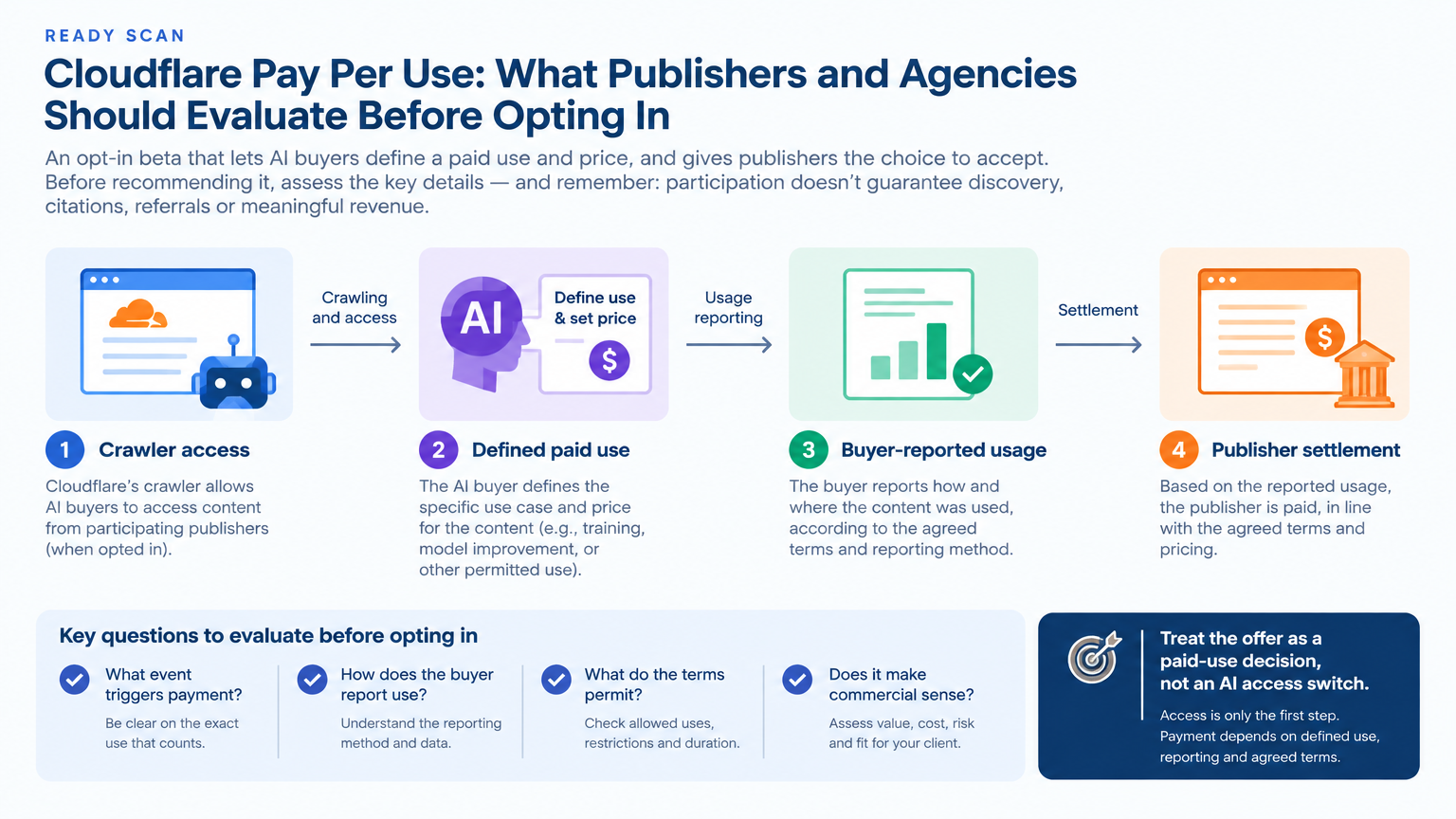
Treat the offer as a paid-use decision, not an AI access switch
Cloudflare announced Pay Per Use as a beta on September 30, 2026. Its basic proposition is straightforward: an AI company defines a use for which it will pay and sets a price; a publisher chooses whether to accept the offer and can stop participating. Cloudflare describes the service as handling enrollment, usage records, billing and payment, with publishers able to view reported usage and earnings in a dashboard.
For an agency, the key point is that this is an opt-in commercial arrangement, not automatic payment whenever a bot visits a page. A crawler may fetch many pages and use only some of them. Pay Per Use is intended to attach payment to a buyer-defined downstream use. A publisher therefore needs to assess the offer itself: what counts as a use, what the buyer will pay for that event, and what permissions accompany acceptance.
Keep this separate from crawler access. Cloudflare distinguishes Pay Per Use from Pay Per Crawl, which charges for access. A client can manage whether crawlers may access its content and separately decide whether a particular downstream-use offer is acceptable. Accepting an offer should not be presented as a blanket instruction to open every page to every AI system, and controlling crawler access should not be confused with accepting a payment program.
That distinction is useful in client conversations. Instead of asking only, “Should we allow AI crawlers?”, define the decisions separately: which content should be accessible to which systems, and whether a named buyer’s stated use and terms are worth accepting. If the commercial offer changes, the client can evaluate that offer on its own merits without treating all access policy as settled.
Sources: Pay Per Use: when AI uses your work, you should get paid; The Internet has a second audience
Read the paid-use definition before judging the price
The buyer defines the event it will pay for, so the definition is the centre of the offer. Cloudflare gives two examples: a search service might pay when it returns an excerpt from an enrolled page to a customer; a shopping agent might pay when an enrolled review shapes a recommendation, even if the shopper never reads that review. Those are different events, and they may have different value to a publisher.
Do not compare two offers by headline price alone. First translate each definition into a clear operational statement: “Payment is due when the buyer does X with content from an enrolled page.” Then check whether the stated event matches what the client considers valuable. A displayed excerpt, a citation, a passage used in a report, and an input that influences a recommendation are not interchangeable forms of use. Nor does a page visit, by itself, establish that any of these downstream events occurred.
Ask the buyer or review the program terms for the boundaries of the event. For example: which products or features are covered; how a use is associated with a publisher and URL; whether repeated or combined uses count separately; whether the event depends on a citation, a displayed passage, or another action; and what exclusions apply. These are questions for evaluating a particular offer, not assumptions about what every program includes.
A simple comparison can help the account team focus the discussion:
| Decision point | What to establish | Why it matters |
|---|---|---|
| Qualifying event | The precise action that triggers payment, stated in observable terms. | A broad or unclear definition makes the commercial value difficult to assess. |
| Content scope | Which enrolled domains, pages or content types can be involved. | The client should know whether the offer applies to priority material, the archive, or both. |
| Price basis | The proposed amount and how it applies to a qualifying event. | The number only becomes meaningful when matched to the event and expected usage. |
| Permitted use | What the program terms allow the buyer to do with the content, including any training restrictions. | Payment and permission are connected in the offer terms, but payment alone does not explain the full scope of use. |
| Reporting and settlement | What is reported, how it is reviewed, and how billing and publisher payment work. | The client needs to understand how reported activity becomes an account record and payment. |
Only after these points are clear does it make sense to ask whether the price is attractive. The client may value a current specialist article differently from an older archive page, but do not assume the beta supports page-by-page pricing or counteroffers in every case. Cloudflare describes those as possibilities it wants to support over time, not as a basis for treating every current offer as individually negotiable.
Sources: Pay Per Use: when AI uses your work, you should get paid
Understand what usage reporting establishes, and what it leaves open
In the beta arrangement described by Cloudflare, the buyer reports each use. Cloudflare says each report includes when the use happened, the URL the content came from, and an event ID. The reports are self-reported, and Cloudflare checks whether each reported use maps to an enrolled publisher. Reported uses are aggregated for monthly settlement, and publishers can view reported usage and earnings in the Cloudflare dashboard.
Cloudflare describes dashboard reporting by buyer and domain over time. That gives a publisher a record of what the buyer says it used, associated with an enrolled publisher, and a process for monthly billing and payment. It does not mean Cloudflare independently observes every downstream use or verifies the full commercial meaning of each event. Nor does the description establish that every field in the buyer’s report is visible to publishers in the dashboard. The distinction matters when a client asks how much confidence to place in a usage total. A mapped record and a buyer’s reporting obligation are useful controls; they are not the same as independent verification of every reported event.
Before opting in, ask how the particular program presents and handles reporting details. Which fields will the publisher actually see? Are URL, date and event identity available at the level needed to review a report? Can a publisher inspect records by buyer and domain? How are corrections or disputed reports handled? What details are available to reconcile a dashboard total with the settlement? Confirm the actual program terms rather than assuming a beta dashboard answers all of these questions.
Also clarify the money flow and the obligations around it. Cloudflare says it aggregates reported uses, charges the buyer and pays publishers monthly through a connected payment account. For the client’s decision, confirm the applicable price and payment terms, any account or eligibility requirements, and how to handle taxes, fees, currency or adjustments if those topics are material to the offer. These are due-diligence questions to resolve in the specific terms; the available description does not set out every publisher’s commercial or accounting details.
A useful agency practice is to record the offer version and accepted terms, the date participation begins, the enrolled domains or scope, and the reporting period being reviewed. When the first reports arrive, compare the reported events with the offer’s definition and the client’s expectations. If reporting detail is too limited to support a decision about continued participation, flag that as a program-fit issue rather than presenting the dashboard total as a fully audited measure.
Sources: Pay Per Use: when AI uses your work, you should get paid
Keep discovery and payment expectations grounded
A commercial payment program and an AI discovery pilot answer different questions. Cloudflare’s October 15, 2026 post describes early results from a joint discovery pilot with OpenAI, launched in July and involving a participating cohort of about 1% of Cloudflare’s network. Cloudflare says the pilot helped OpenAI discover and index hundreds of millions of previously unknown pages. That is a reported result about discovery and indexing in that pilot. It does not show that a particular publisher will be cited, receive referrals, qualify for paid uses or earn revenue.
For a publisher, those are separate steps with different evidence: a page may be discoverable; an AI system may index it; a product may later use it in a way that meets a paid-use definition; and a person may or may not visit the publisher or take a commercial action. None of those outcomes should be used as a proxy for another. In particular, do not sell participation internally as guaranteed AI visibility or a new revenue line before the client has an offer, understands its terms and sees relevant usage reports.
Set the client’s expectation around the decision they can actually make now: whether a specific buyer’s definition, price, permissions, reporting and settlement arrangements are worth considering. If there is no offer, there is no price to evaluate. If the offer’s qualifying event is unclear, anticipated earnings cannot be estimated responsibly from the available description alone. If reported usage later appears, it is evidence of reported paid events under that program, not a guarantee of traffic or broader market visibility.
This is not a reason to dismiss the model. A defined paid-use offer may give a publisher another way to make selected content available to an identified buyer on stated terms. The practical question is whether the proposed arrangement fits the client’s content, commercial priorities and tolerance for the reporting model, not whether the model promises every outcome the marketing team wants.
Sources: Cloudflare and OpenAI: Making AI discovery better for everyone; Pay Per Use: when AI uses your work, you should get paid; The Internet has a second audience
Turn the offer into a client decision with a clear review point
An agency recommendation should end with a decision the client can make, not a prediction the available information cannot support. A practical review can be organized around five questions:
What is the client trying to achieve? Identify whether the priority is to monetize a defined use, manage access, or understand AI discovery. Do not treat these as one objective.
What exactly triggers payment? Write the buyer’s qualifying event in plain language and confirm the content scope it covers.
What does acceptance permit? Review the program terms for permitted uses and any restrictions, including training provisions. Keep the offer’s actual language and the client’s approval on record.
How will use and payment be reported? Confirm what the buyer reports, what Cloudflare checks, what appears in the dashboard, how monthly settlement works, and what process applies if a record needs clarification.
When will the client reassess? Agree who will review the first reports and terms in practice, when that review will happen, and what would make participation worth continuing or stopping.
A sensible initial decision may be to accept a clearly defined offer for a client’s chosen scope, decline an offer whose event or permissions do not fit, or defer a recommendation until the buyer clarifies the terms. Each is a valid commercial outcome. Avoid treating acceptance as a permanent policy choice: Cloudflare says publishers can stop participating, so the client can review the arrangement as it develops, subject to the program terms.
For the first review, compare what was reported with what the offer said would count, whether the reporting is useful enough for the client’s purpose, and what payment was actually settled. Keep separate any evidence of citations, referral visits or business outcomes. If the offer produces little reported use, that is a reason to reassess its value for this client, not evidence that AI discovery as a whole has failed. If reported uses occur, they may justify continued participation, but do not by themselves establish that the arrangement drove new traffic or customers.
The agency’s role is to translate an unfamiliar mechanism into a manageable choice: a defined event, a price, a permitted-use scope, a reporting model and a review point. That gives the publisher a grounded way to say yes, no or not yet, while preserving separate decisions about crawler access and broader AI visibility.
Sources: Pay Per Use: when AI uses your work, you should get paid
Sources
- Cloudflare and OpenAI: Making AI discovery better for everyoneCloudflare · Accessed Explore publications using this source
- Pay Per Use: when AI uses your work, you should get paidCloudflare · Accessed Explore publications using this source
- The Internet has a second audienceCloudflare · Accessed Explore publications using this source