
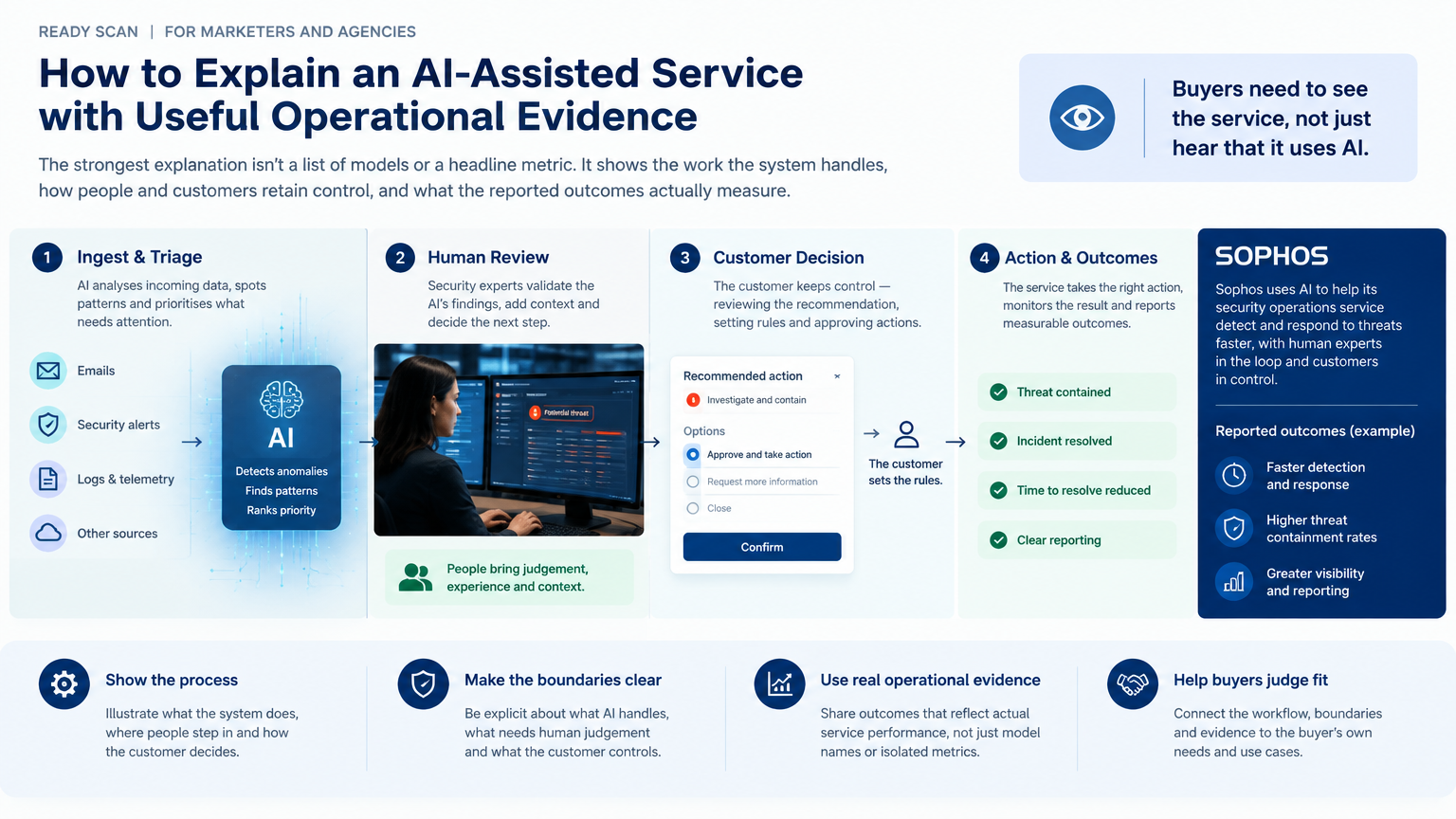
Buyers need to see the service, not just hear that it uses AI
“AI-powered” tells a prospect that technology is involved. It does not tell them what the service will do for their team, what happens when the system is uncertain, or who is accountable for consequential decisions. Those are the questions that affect whether an offer feels credible and relevant.
A useful service explanation connects three things:
The work: what information comes in, what the system does with it, and what it produces.
The operating boundary: which tasks can proceed automatically, where a person reviews or intervenes, and what control the customer retains.
The evidence: what outcome was observed, for which work, and against what comparison or baseline.
This gives a buyer something more valuable than a technology label: a way to picture how the service fits into real operations. It also helps marketing, sales and delivery teams tell the same story. A headline can attract attention, but the workflow and decision boundaries are what let a prospect evaluate the promise.
The aim is not to make technical implementation sound impressive at any cost. It is to translate the implementation into a clear account of the service, preserving what it does and does not establish. That is particularly important when automation handles only part of a wider service or when its authority depends on customer preferences.
Sources: Singapore Airlines elevates travel & work with OpenAI technology | OpenAI
Explain the workflow as a chain of work and handoffs
A buyer-facing explanation becomes concrete when it traces a case from input to next action. Name the information the service uses, the steps it performs and the point at which a person or customer takes over. Avoid using “agent” as if the term itself explains the work. Describe the responsibility instead.
The OpenAI-published Sophos case gives a useful example. Sophos says an investigation agent gathers customer context, detections, indicators of compromise and relevant threat intelligence for a case. A planning model then uses a plan-execute-review loop: it creates an investigation plan, carries out steps and produces a summary with recommended response actions for analysts to review. Other agents can carry out parts of the response.
The OpenAI-published Qodo case shows another kind of handoff. Qodo’s Codex plugin retrieves relevant codebase rules and pull-request history before Codex writes code. After the changes, Qodo reviews them and returns findings to Codex in the same session, before the developer opens a pull request. Qodo describes human expertise as resolving questions that remain. The example makes clear how context gathering, creation, independent review and human judgment can have distinct roles.
A third example, Cloudflare’s early-access vulnerability service, shows how operational evidence can connect analysis to a proposed next step. Cloudflare says the service investigates customer-authorized code using live traffic and security signals, prepares proposed mitigations and patches, and checks and reviews those proposals before sharing them with customers. Customers retain control over which changes to implement. For a buyer, this makes both the basis for prioritizing work and the boundary between a recommendation and an approved change visible.
Together, these examples show why sequence matters. A prospect can distinguish information gathering from planning, execution from review, and recommendations from actions carried out. That is far more informative than saying only that a service uses advanced AI to do the work.
When translating a technical design for a service page, proposal or client presentation, make the handoffs visible. For each stage, answer:
What information or request enters?
What task does the system perform?
What output or recommendation does it produce?
Who checks, approves or acts on that output?
What happens when the case falls outside the system’s remit?
Do not imply every case follows an identical path if the operation includes exceptions or different customer settings. The right level of detail is enough for a buyer to understand what the service actually delivers and where responsibility moves between system, provider and customer.
Sources: Sophos cuts threat investigation time by 96% with OpenAI Daybreak | OpenAI; Qodo builds context into AI code review with Codex | OpenAI; Cloudflare links vulnerability discovery to defense with OpenAI | OpenAI; Singapore Airlines elevates travel & work with OpenAI technology | OpenAI; JioStar’s chief architect on AI discovery at 500M-user scale | OpenAI; Stack Overflow for Agents triples signups with ChatGPT plugin | OpenAI
Put human judgment and customer control in the service story
“Human in the loop” is too vague to reassure a buyer on its own. Explain what people review, what decisions they can make, and which actions the customer authorizes. This turns oversight from a slogan into an operating boundary.
In the Sophos case, customers can work in three modes: Notify, where Sophos investigates and recommends a response but the customer acts; Collaborate, where Sophos and the customer work together before action; and Authorise, where Sophos can respond on the customer’s behalf. The case says the same boundaries apply whether work is completed by a person or an agent, and potentially destructive actions require the appropriate human oversight. It also describes passing work to human judgment when an agent is not considered suitable to handle it.
For marketers, the lesson is not to copy those mode names into unrelated offers. It is to make the actual control model legible. Explain whether the system can recommend, prepare, execute or finalize an action. State what requires customer approval, what an employee reviews, and what triggers escalation. Where customers choose among operating modes, say how that choice changes the service.
A practical test for the draft is simple: could a buyer identify who is accountable at the point where an action affects their business? If not, clarify the handoff before making the automation claim more prominent. That detail can help buyers compare services on a meaningful basis, especially when the advertised benefit is speed but the work also carries operational risk.
Sources: Sophos cuts threat investigation time by 96% with OpenAI Daybreak | OpenAI; Qodo builds context into AI code review with Codex | OpenAI; Cloudflare links vulnerability discovery to defense with OpenAI | OpenAI; Singapore Airlines elevates travel & work with OpenAI technology | OpenAI; JioStar’s chief architect on AI discovery at 500M-user scale | OpenAI
Make every outcome carry its scope
A strong metric needs more than a large number. Buyers need to know what was counted, which work was included, and what the comparison represents. Without that context, a figure can sound like a universal promise when it is actually an outcome from a particular operation.
The OpenAI-published Sophos case reports an average response time of about 89 seconds for cases using AI agents. It also describes an earlier average of around 38 minutes for investigating and responding to a case, and separately reports a 96% reduction in investigation time using OpenAI models. The case does not label these figures identically, so keep the 89-second response-time figure distinct from the investigation-time reduction. It also reports that AI resolved 52% of MDR cases end-to-end. That figure describes MDR cases, not all work across the service. These are reported case outcomes, not general benchmarks or guarantees for other organizations.
The OpenAI-published Singapore Airlines case offers a separate customer-service example. Singapore Airlines reports a 2x increase in customer satisfaction score after moving its Kris chatbot from a traditional dialog-flow system to an LLM-powered conversational experience. It also reports an approximately 10% reduction in average handling time for customer service representatives using AI-assisted tools, including call summarization. These figures describe different measures and workflows: chatbot CSAT and representative handling time. The case also reports nearly 3x growth in Flight Recommender monthly users over the past year. That is a usage measure, not a direct measure of service quality or revenue. Keep the stated workflow and measure attached to each result, and do not present them as forecasts for another organization.
Preserve those distinctions wherever the results appear: in a headline, sales deck, case-study summary, proposal or campaign. Do not shorten “average response time for cases using AI agents” to “response time” if that would suggest the figure covers every case. Do not recast the reported 96% investigation-time reduction as a 96% reduction in response time, or treat “52% of MDR cases resolved end-to-end by AI” as “52% faster” or as evidence that every task in the wider service is automated.
A useful outcome statement answers four questions in the same context:
What changed? Name the measured result, such as response time, investigation time or share of cases resolved.
Which work is covered? Specify the case type, process, customer group or service segment that the figure describes.
What is the comparison? Explain the baseline or prior process, and avoid implying a like-for-like or controlled comparison if that is not what is reported.
What stays outside the claim? Make clear what the metric does not establish, such as a universal service result, a customer-specific guarantee or a GEO visibility gain.
Also distinguish operational measures from buyer and business outcomes. In an OpenAI-published interview, JioStar’s chief architect describes balancing accuracy, latency and cost, and says production monitoring should include model efficacy. He also cautions that activity measures, such as lines of code generated, do not show whether meaningful value was created. For client reporting, label each measure by what it tells you: operational performance, service or customer outcomes, or business impact. State the workflow and period it covers, use operational measures to spot where a process may need attention, and do not imply revenue or customer impact that the measure does not establish. Where production feedback or failures are available, teams can also use them to refine evaluation cases, with domain experts helping assess what good performance means.
The point is not to bury a strong result in qualifications. It is to make the result more useful to a buyer by showing what it can reasonably inform. A precise claim often gives sales teams a better conversation: prospects can ask whether their own work resembles the measured workflow and what operational conditions would matter.
Sources: Sophos cuts threat investigation time by 96% with OpenAI Daybreak | OpenAI; Qodo builds context into AI code review with Codex | OpenAI; Cloudflare links vulnerability discovery to defense with OpenAI | OpenAI; Singapore Airlines elevates travel & work with OpenAI technology | OpenAI; Stack Overflow for Agents triples signups with ChatGPT plugin | OpenAI
Turn implementation details into a buyer-ready evidence brief
For an agency team, the practical deliverable is not just cleaner copy. It is an agreed account of how the service operates and which claims the evidence supports. Build it with the people closest to delivery, then use it to align the website, pitch, sales conversation and reporting.
Start with one important service workflow. Ask the delivery team to describe a typical case from intake to resolution, including exceptions. Then capture the answers in a short working brief:
Service promise: what problem the service is designed to address, stated in the buyer’s terms.
Process: inputs, system tasks, outputs and handoffs, in operational order.
Decision rights: what the system may do, what a person reviews, what the customer approves, and when work escalates.
Evidence: the outcome, population or work measured, comparison used, and any conditions that affect interpretation.
Claim boundaries: what should not be inferred from the process or result.
Proof owner: who in delivery or operations can confirm that the description remains accurate as the service changes.
This brief helps teams avoid two common content problems. One is abstraction: calling a service intelligent or autonomous without describing its work. The other is overreach: using a real result to imply that all clients, cases or tasks will experience the same outcome.
Use the brief to create content for the decision in front of the buyer. A service page may need a plain-language workflow and clear control boundaries. A proposal may need to connect the workflow to the prospect’s particular operating model. A case study can foreground the measured outcome, provided it carries its scope with it. A sales team may need a concise answer to what happens when the system is unsure. These are different expressions of the same operational truth, not separate stories to invent.
Before publishing, ask a delivery owner to review the descriptions of system actions, human review and customer control. Ask marketing to check that the outcome retains its measurement scope and that the copy does not turn a reported case result into a promise. Completion means a prospective buyer can explain, in their own words, what the service does, where judgment remains and what the evidence says. If they cannot, simplify the explanation or make the handoffs clearer before adding more technical detail.
Sources: Sophos cuts threat investigation time by 96% with OpenAI Daybreak | OpenAI; Qodo builds context into AI code review with Codex | OpenAI; Cloudflare links vulnerability discovery to defense with OpenAI | OpenAI; Singapore Airlines elevates travel & work with OpenAI technology | OpenAI; JioStar’s chief architect on AI discovery at 500M-user scale | OpenAI; Stack Overflow for Agents triples signups with ChatGPT plugin | OpenAI
Treat GEO visibility as a separate observation
Operational evidence makes a service easier to understand and evaluate. It does not, by itself, establish that an AI answer engine will cite, recommend or surface the service. The Sophos case describes a workflow and reports outcomes; it does not establish that this style of explanation increases AI citations or recommendations.
For client reporting, keep three questions distinct:
Is the service clear? Can a buyer understand the work, the handoffs and the boundaries?
Is the operational claim supported? Does the available evidence match the wording and scope of the outcome?
What visibility was observed? Did an AI answer mention or cite the brand, and in what context?
These signals can inform different decisions. A clearer workflow may improve a sales conversation because the buyer understands what is included. A scoped outcome may make a case study more credible and useful. An AI mention or citation is a separate observation, not proof that either content change caused the answer or that the mention produced demand.
If you monitor AI answers, record the prompt or question, the answer wording, any source reference and the date of observation in your own reporting process. Compare observations over time, but do not turn a small set of answers into a market-wide visibility claim. Keep business measures such as qualified enquiries, sales conversations and attributable outcomes in their own reporting context.
The next practical step is to choose one service workflow that prospects often misunderstand. Map its process, identify the human and customer decision points, and attach only the outcomes that genuinely describe that work. Review the resulting explanation with delivery and sales. That is a useful marketing improvement in its own right: it gives buyers a clearer basis for deciding whether the service fits, without asking a metric or an AI system to stand in for the explanation.
Sources: Sophos cuts threat investigation time by 96% with OpenAI Daybreak | OpenAI; Stack Overflow for Agents triples signups with ChatGPT plugin | OpenAI
Sources
- Sophos cuts threat investigation time by 96% with OpenAI Daybreak | OpenAIOpenAI · Accessed Explore publications using this source
- Qodo builds context into AI code review with Codex | OpenAIOpenAI · Accessed Explore publications using this source
- Cloudflare links vulnerability discovery to defense with OpenAI | OpenAIOpenAI · Accessed Explore publications using this source
- Singapore Airlines elevates travel & work with OpenAI technology | OpenAIOpenAI · Accessed Explore publications using this source
- JioStar’s chief architect on AI discovery at 500M-user scale | OpenAIOpenAI · Accessed Explore publications using this source
- Stack Overflow for Agents triples signups with ChatGPT plugin | OpenAIOpenAI · Accessed Explore publications using this source