
A recommendation depends on the learning job
A parent looking for P1 phonics is not asking the same thing as one seeking non-drill reading comprehension for a P2 child, a low-pressure way for a shy child to speak, or a P4 writing class in Sha Tin. The age, skill, learning format and district are part of the buying task, not incidental details. A centre can be a plausible choice for one question and a less clearly supported choice for another.
That distinction matters in GEO work. If a brand appears in an answer, the next question is not simply “Did we win visibility?” Ask instead: What did the buyer need, what role did the answer give the brand, and did the answer explain a specific fit? Those questions lead to more useful client decisions than treating every mention as equivalent.
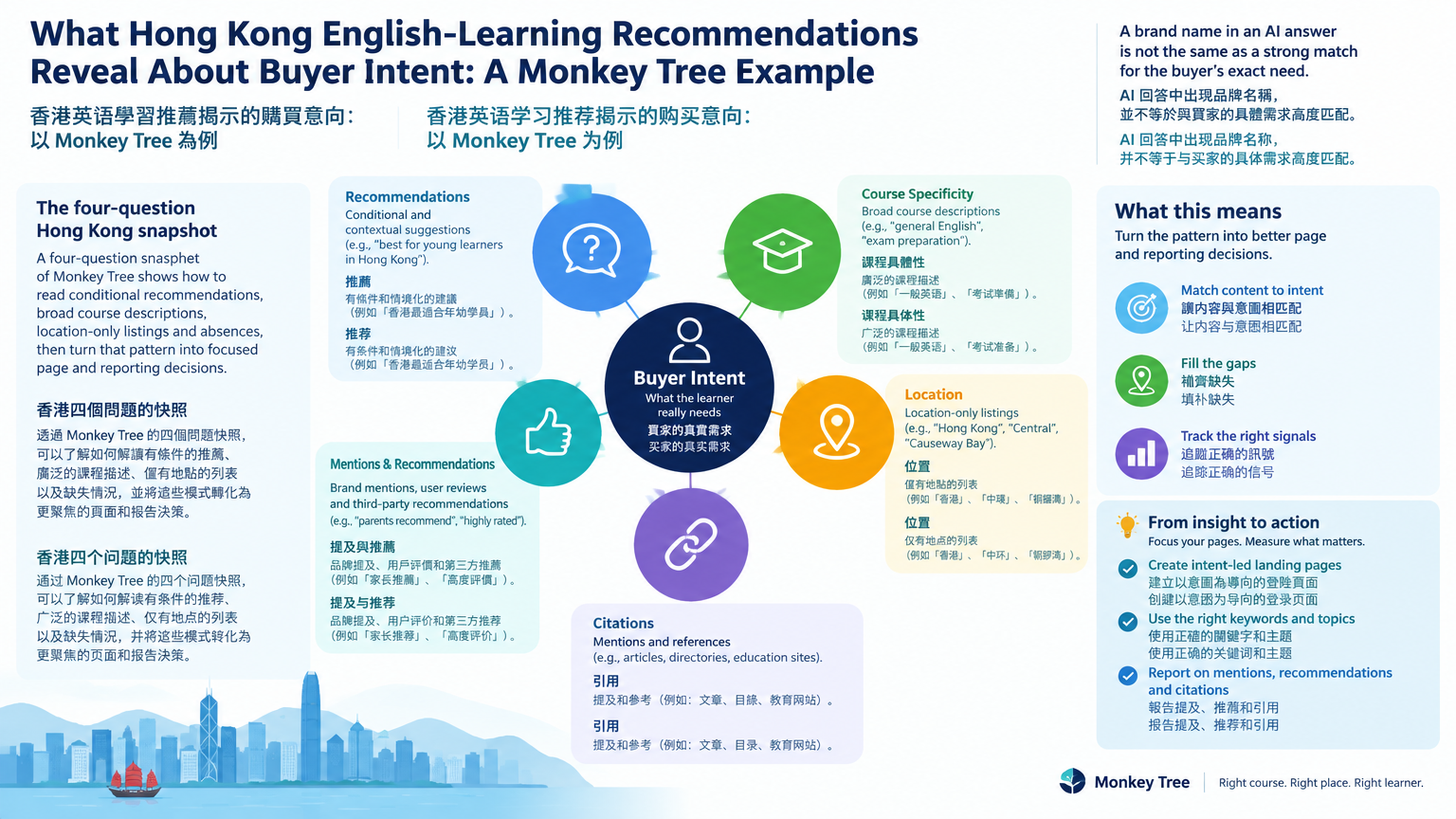
A Ready Scan observation of Monkey Tree, captured on 29 October 2026, offers a concrete example. It covers four Hong Kong English-learning questions, each answered by Claude, ChatGPT and Gemini. Across the twelve answers, Monkey Tree was mentioned in seven and classified as recommended in six. Those totals are a useful orientation, but they flatten the more actionable story: the roles varied considerably by question and assistant. This is a snapshot of those answers, not a stable market ranking or evidence about what caused any answer.
Sources: Monkey Tree: public GEO observations
The same brand played a different role in each question
The four questions reveal a useful range, from a named option with a relevant rationale to a bare branch listing or no mention at all.
| Buyer question | What the observed answers did with Monkey Tree | What that tells a marketer |
|---|---|---|
| P1 phonics in Hong Kong | Claude presented it as an established, multi-branch option; Gemini described convenience and a gentle introduction. ChatGPT did not name it and instead gave detailed P1 phonics information for other centres. | General phonics relevance and convenience can earn a place, while a competing answer may be more explicit about grade fit and course details. |
| P2 reading comprehension beyond drills | Only ChatGPT named Monkey Tree, as a broad Reading & Speaking option, and advised checking whether the class includes the desired comprehension work. | A broad course label can open the door, but the buyer’s specific learning task still needs substantiation. |
| Shy child who needs to speak more | Claude framed it as a convenient nearby choice; Gemini presented a game-based option. ChatGPT did not mention it. | Interaction and convenience may be a plausible angle, but answer presence varied across assistants. |
| P4 writing in Sha Tin | Claude listed branches without course details; Gemini recommended it in a writing comparison; ChatGPT did not name it. | A location listing is not course fit. One answer made a course-level connection, while another did not. |
The P1 comparison is especially instructive. Claude linked Monkey Tree to being an established option with multiple branches, while Gemini emphasized convenience and an easy-going introduction. Neither answer, as observed, provided the same level of specific P1 course detail that ChatGPT gave for some other centres. ChatGPT’s omission is not proof that Monkey Tree cannot serve a P1 learner. It does show that, in that answer, other providers had more explicit course facts available to support the comparison.
The P2 answer makes the gap between category and task fit even clearer. “Reading & Speaking” is a relevant broad category, but the buyer asked for reading comprehension without simply doing drills. The answer itself suggested checking whether classes actually include the desired comprehension work. That is a practical signal for a marketer: clarify what the course does, not just the umbrella skill area it belongs to.
The Sha Tin writing question shows why presence can be weak evidence. Claude included Monkey Tree as a centre with branches in the district but supplied no course details. Gemini described it as a writing option. Those are different answer roles. The branch listing helps a local buyer establish possible convenience; it does not, by itself, establish that the branch offers the requested P4 writing class. A course-level recommendation is a stronger signal of how the answer framed fit, but it still does not verify current course availability, grade eligibility or delivery at a particular branch. Confirm those facts before using the answer as client-facing evidence or promising a content change.
Sources: Monkey Tree: public GEO observations
Four outcomes to keep separate in client reporting
A useful read of the snapshot starts by distinguishing four outcomes that often get collapsed into one visibility number:
Mention: The answer names the business. It establishes that the brand appeared, not that it was recommended or well matched.
Recommendation: The answer proposes the business for the stated need. Note whether the case is conditional, broad or specific to the requested course and learner.
Citation: The answer refers to a source page. That may show a page surfaced, but the answer can cite it without naming or recommending the business.
Absence: The answer does not name the business. This is an observation about that response, not a diagnosis of why it was missing.
In this snapshot, the first three questions each had a target-cited answer, while the Sha Tin writing question had none. A citation still needs to be interpreted alongside the answer: for instance, an answer can cite a broad company page and name a general course without resolving the buyer’s more specific requirement. Conversely, Gemini recommended Monkey Tree for the P1 and P4 questions without a cited Monkey Tree source in its recorded answer. So citation and recommendation are related but distinct measures.
The recommendation label also needs context. Six of the twelve answers were classified as recommendations, but none was classified as a strong first choice or clear positive recommendation. The six were conditional recommendations. That points to a meaningful distinction for sales and account teams: “an option worth checking for this situation” can be commercially useful, but it is not the same as “the leading choice for this exact course need.”
When you present results, keep the complete answer and the intent beside the label. A simple report line such as “mentioned in seven of twelve answers” is easy to read but too thin to guide a content brief. A stronger record says which buyer question was asked, how the answer positioned the business, whether a page was cited, and what decision the answer left for the parent to verify.
Sources: Monkey Tree: public GEO observations
Turn the pattern into a course-fit decision, not a visibility reflex
For marketers and agencies, the practical question is what to change, if anything. The four intents suggest three different routes. Keep them distinct, because each route calls for different client work.
If the course fits, make the fit easy to understand
If Monkey Tree offers a course that genuinely serves the requested learner and need, the relevant pages should help parents answer concrete questions without inference. For a phonics course, that could mean making eligible ages or grades clear, explaining whether phonics is explicitly taught, and describing the skills or progression parents can expect to review. For a reading-comprehension need, explain whether the course works with complete texts and what comprehension activities it includes, rather than relying on the broad label “Reading & Speaking.” For writing, identify the grades served, the writing skills covered and what kind of course the branch currently runs.
These are examples of useful information to present if it reflects the actual offer, not a checklist that guarantees an AI recommendation. The goal is to help parents assess fit and give answers a clearer basis for describing it.
If location is the clearest advantage, connect it to the actual offer
Convenience appeared in some answers: the brand was framed as a nearby or multi-branch option, and the P4 question explicitly named Sha Tin. Location can be relevant to a family choosing an after-school class. But a location listing alone does not answer whether the particular branch offers the right course, grade, schedule or class format.
That makes a useful page decision quite specific: keep branch information clear, and connect it with the courses actually available at that location where that information is confirmed. If the service is not available at a named branch, avoid wording that could imply otherwise. A parent needs both parts of the decision: “Can we get there?” and “Is the course we need offered there?”
If the requested task is not served, target a better-fit question
A brand does not need to stretch a broad English offer into a specialist claim. The supplied company information for alternatives illustrates why course specificity matters. ABC Pathways describes an English programme based on the UK National Curriculum and ability grouping, but the supplied description does not specify a P1 phonics class or syllabus. The British Council describes dedicated phonics for K1–K3 and a broader primary English course for P1–P6, without specifying P1 phonics in that primary course. English Excel describes an individual learning plan and classes for ages 3–18, but the supplied information does not specify a dedicated P1 phonics course. These examples show that even a broad English offer or an adjacent-age course is not the same as documented fit for a particular P1 phonics requirement.
The same discipline applies to Monkey Tree. If a page does not document the exact course fit, first confirm what is currently offered. If the business does not serve that need, do not create copy that implies it does. Put effort into buyer questions the business can answer well, and describe the boundaries of the offer plainly.
Sources: Monkey Tree: public GEO observations
A practical audit and retest for agency teams
A useful client conversation moves from “Why were we missing?” to a small number of questions the business can answer.
Pin down the buyer task. Preserve grade, skill, location and learning preference. “English class” is not specific enough to explain a P1 phonics comparison or a P4 writing search in Sha Tin.
Read the complete answer. Record whether the brand was recommended, broadly mentioned, cited without a recommendation, listed only for its location or absent. Keep the assistant’s wording and alternatives; a label on its own loses the reasoning.
Check the actual course facts. Confirm current age or grade eligibility, course content, location availability and any distinction between a dedicated skill course and broader English provision. Treat an answer’s course claims as claims made by that answer unless verified against the business’s own information.
Choose one customer-useful change. If a genuine offering is hard to understand, improve the relevant course or location information. If the offering does not fit, refine the target questions or positioning instead of implying a capability.
Retest the same question. After a meaningful update, repeat the same buyer question in the same assistant where practical. Retain the date, full answer and any cited pages. Compare later observations with the original, but do not describe the change as the cause of a different answer based on this snapshot alone.
For a working report, keep a row per intent rather than one blended brand score:
| Intent | Observed role | Page or fact to check | Next decision |
|---|---|---|---|
| P1 phonics | Conditional options in two answers; absent in one | Is the exact P1 phonics offer, eligibility and teaching focus clearly described? | Improve course detail if the offer exists and the information is unclear. |
| P2 comprehension | One broad course mention with an explicit fit-check | Does the relevant class include the comprehension work the buyer asked for? | Clarify actual class content, or focus on a different task. |
| Shy speaker | Nearby or game-based framing in two answers; absent in one | What interaction format and course details are documented for the relevant age? | Make the real speaking offer easier to assess. |
| P4 writing in Sha Tin | One branch-only listing, one course recommendation, one absence | Is a P4 writing course actually offered at the relevant location, and what does it cover? | Connect verified course and location facts, or avoid implying availability. |
This is not a guaranteed GEO playbook. It is a way to tie observation to a customer question, a verifiable business fact and a next decision. The same discipline also prevents teams from treating every AI answer as a verdict or turning a single snapshot into a claim of causation.
The commercial value is in making the offer easier to choose. If the business has a suitable phonics, reading, speaking or writing course, make the fit understandable to the parent who needs it. If it does not, focus on the intents it can serve credibly. Either way, a better report ends with a decision about the offer and the information supporting it, not simply a target to collect more mentions.
Sources: Monkey Tree: public GEO observations
Reports behind this guide
Open a report for its original buyer questions, AI answers and sources.
Monkey Tree · Questions and AI answers
Buyer questions: 4 · Completed AI answers: 12 / 12 · Market / language: Hong Kong · en-US · Observed (UTC): 2026-10-29
Sources
- Monkey Tree: public GEO observationsReady Scan · Accessed Explore publications using this source