
Public observation context
Original report · Exact report snapshot
- Product
- Yoshinoya
- Observation language
- en-US
- Region
- Hong Kong
- Buyer questions
- 4
- Recorded narrative answers
- 12
- Completed narrative answers
- 12
- Supporting searches
- 4
- Full narrative observation period (UTC)
- 2026-10-20T03:38:36.672Z — 2026-10-20T03:40:26.175Z
- Narrative count by date (UTC)
- 2026-10-20: 12
- Report generated
- 2026-10-20T03:51:01.118Z
- Website source captured
- 2026-10-20T03:49:08.215Z
- Narrative models
- claude: anthropic/claude-haiku-5.5; chatgpt: openai/gpt-6-luna; gemini: google/gemini-3.7-flash
Original observation witnesses
Public observation context
Original report · Exact report snapshot
- Product
- 3 Hong Kong
- Observation language
- en-US
- Region
- Hong Kong
- Buyer questions
- 4
- Recorded narrative answers
- 12
- Completed narrative answers
- 12
- Supporting searches
- 4
- Full narrative observation period (UTC)
- 2026-10-20T04:30:11.546Z — 2026-10-20T04:32:11.668Z
- Narrative count by date (UTC)
- 2026-10-20: 12
- Report generated
- 2026-10-20T05:00:18.411Z
- Website source captured
- 2026-10-20T04:30:30.026Z
- Narrative models
- chatgpt: openai/gpt-6-luna; claude: anthropic/claude-haiku-5.5; gemini: google/gemini-3.7-flash
Original observation witnesses
Public observation context
Original report · Exact report snapshot
- Product
- SmarTone
- Observation language
- en-US
- Region
- Hong Kong
- Buyer questions
- 4
- Recorded narrative answers
- 12
- Completed narrative answers
- 12
- Supporting searches
- 4
- Full narrative observation period (UTC)
- 2026-10-20T04:30:11.546Z — 2026-10-20T04:32:11.668Z
- Narrative count by date (UTC)
- 2026-10-20: 12
- Report generated
- 2026-10-20T04:59:56.974Z
- Website source captured
- 2026-10-20T04:30:05.327Z
- Narrative models
- claude: anthropic/claude-haiku-5.5; chatgpt: openai/gpt-6-luna; gemini: google/gemini-3.7-flash
Original observation witnesses
Public observation context
Original report · Exact report snapshot
- Product
- Club Sim
- Observation language
- en-US
- Region
- Hong Kong
- Buyer questions
- 4
- Recorded narrative answers
- 12
- Completed narrative answers
- 12
- Supporting searches
- 4
- Full narrative observation period (UTC)
- 2026-10-20T04:30:11.546Z — 2026-10-20T04:32:11.668Z
- Narrative count by date (UTC)
- 2026-10-20: 12
- Report generated
- 2026-10-20T05:05:58.058Z
- Website source captured
- 2026-10-20T05:04:17.244Z
- Narrative models
- chatgpt: openai/gpt-6-luna; gemini: google/gemini-3.7-flash; claude: anthropic/claude-haiku-5.5
Original observation witnesses
Public observation context
Original report · Exact report snapshot
- Product
- Saizeriya
- Observation language
- en-US
- Region
- Hong Kong
- Buyer questions
- 4
- Recorded narrative answers
- 12
- Completed narrative answers
- 12
- Supporting searches
- 4
- Full narrative observation period (UTC)
- 2026-10-20T03:38:36.672Z — 2026-10-20T03:40:26.175Z
- Narrative count by date (UTC)
- 2026-10-20: 12
- Report generated
- 2026-10-20T03:53:51.895Z
- Website source captured
- 2026-10-20T03:49:50.846Z
- Narrative models
- chatgpt: openai/gpt-6-luna; claude: anthropic/claude-haiku-5.5; gemini: google/gemini-3.7-flash
Original observation witnesses
Public observation context
Original report · Exact report snapshot
- Product
- CUniq
- Observation language
- en-US
- Region
- Hong Kong
- Buyer questions
- 4
- Recorded narrative answers
- 12
- Completed narrative answers
- 12
- Supporting searches
- 4
- Full narrative observation period (UTC)
- 2026-10-20T04:30:11.546Z — 2026-10-20T04:32:11.668Z
- Narrative count by date (UTC)
- 2026-10-20: 12
- Report generated
- 2026-10-20T05:10:29.895Z
- Website source captured
- 2026-10-20T05:05:58.956Z
- Narrative models
- claude: anthropic/claude-haiku-5.5; chatgpt: openai/gpt-6-luna; gemini: google/gemini-3.7-flash
Original observation witnesses
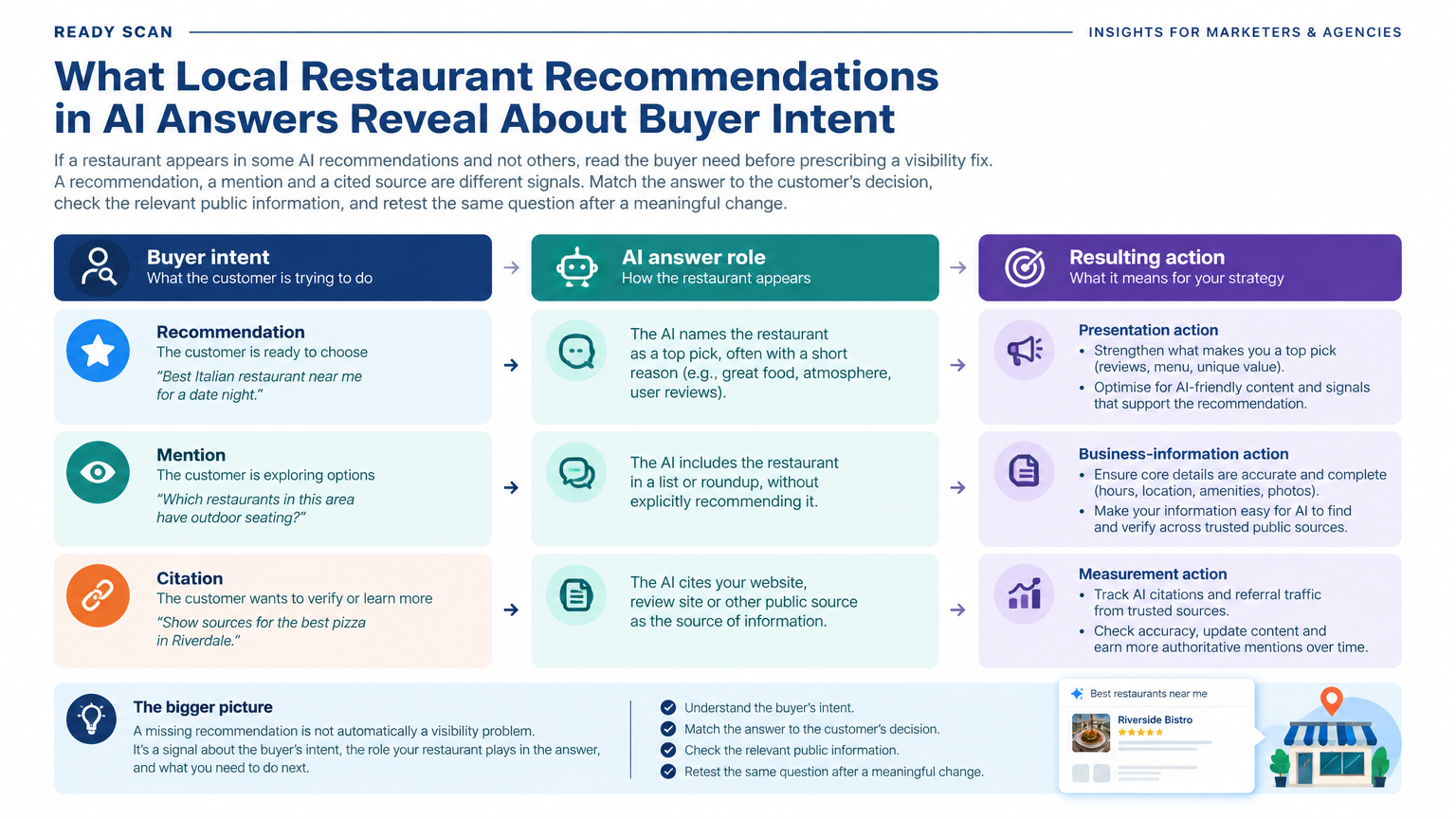
A missing recommendation is not automatically a visibility problem
When a restaurant appears in one AI answer and disappears from another, the natural reaction is to ask what visibility work is missing. Start instead with the customer’s question. A person looking for a weekday lunch under HK$70, a quick meal near work, a family dinner in Sha Tin, and a breakfast with a clear menu are making different decisions. The same restaurant can be a reasonable fit for one and irrelevant to another.
That is the useful distinction between intent fit and general visibility. Intent fit asks whether the offer answers the particular need expressed in a question. General visibility asks how often the brand shows up across a wider set of questions. A restaurant missing from a breakfast comparison may have a weak breakfast proposition, may not be understood as a breakfast option, or may simply not be surfaced in those answers. Those explanations suggest different actions, so an absence alone cannot tell you which one is true.
For marketers and agencies, this is more than a reporting nuance. If every absence becomes a mandate to “do more GEO,” teams can end up rewriting pages that already explain the offer, publishing content for needs the business does not serve, or chasing mentions in questions unlikely to drive a visit. Read the buyer task first. Then decide whether the issue is fit, how the offer is described, whether supporting business information is available, or whether the observation needs better measurement.
Read the kind of visibility, not just the brand name
A brand name in an answer does not always mean the answer recommends that business. Likewise, a source link can appear without the brand being named. Keep three signals separate:
Mention: The answer names the brand. This establishes that it appeared, but not that it fits the need or was recommended.
Recommendation: The answer suggests the brand for the buyer’s stated situation. Note whether the suggestion is clear, conditional, or merely one option among several.
Citation: The answer references a brand-owned or other source. A cited page may support a specific detail without the answer recommending the business, or even naming it.
For example, “Brand A is a local chain” is a mention. “Brand A is worth considering if you need a quick rice lunch nearby” is a recommendation connected to a need. A Brand A menu page cited in an answer that never names the restaurant is a citation, not a recommendation. Reporting all three as “AI visibility” without qualification can make performance look stronger or weaker than the buyer-facing answer warrants.
A useful review asks what role the brand plays in the complete answer: Is it presented as a strong fit, a conditional choice, a supporting alternative, a bare name, a cited source, or absent? Keep the surrounding language and competing options with the record. That context makes the observation actionable instead of turning it into a vanity count.
Sources: Yoshinoya: public GEO observations; Saizeriya: public GEO observations
Two local restaurant snapshots, two different intent patterns
Ready Scan observations captured on 20 October 2026 offer a useful prompt-level illustration. In the Yoshinoya snapshot, the restaurant was recommended in three of twelve retained answers across questions about a weekday lunch under HK$70, a quick Kwun Tong lunch, and a family dinner in Sha Tin. The answer descriptions and the role assigned to Yoshinoya varied with the question. Breakfast-comparison answers in this observation set did not name it. In one Kwun Tong ChatGPT answer, a Yoshinoya website source appeared even though the recommendation did not name the restaurant.
In the separate Saizeriya snapshot, the brand was recommended in two of twelve retained answers, both about a weekday lunch under HK$70. One ChatGPT answer cited Saizeriya’s lunch-menu page while recommending set options. The remaining observed questions did not name the brand.
The difference is useful as a way to think about intent, not as a contest between the brands. The question sets and answer contexts differ, so the counts are not a market-share comparison or a reliable ranking. Each snapshot is a record of answers at an observation point, not proof of current offers or a stable market pattern.
The public information also has different roles. Yoshinoya’s supplied menu page presents menu categories including lunch and student sets, as well as items such as beef bowls and Japanese curry rice; the captured page text gives no prices. Saizeriya’s supplied shop-information page lists locations, hours and takeaway links. The lunch-menu page cited in one answer is the relevant company source for the set-menu description. Keep those company-published details distinct from AI-generated descriptions. An answer’s account of a price, inclusion or offer is not confirmed as current just because it appears in a recommendation.
The practical lesson is already visible: Yoshinoya’s recommendations cluster around several meal occasions, while Saizeriya’s observed recommendations cluster around the under-HK$70 weekday lunch question. That is a prompt-level clue about how the answers framed each offer, not a verified statement about the restaurants’ complete positioning or current menus.
Sources: Yoshinoya: public GEO observations; Yoshinoya: public website context; Saizeriya: public GEO observations; Saizeriya: public website context; SmarTone: public GEO observations; SmarTone: public website context; Club Sim: public website context; CUniq: public website context; CUniq: public GEO observations; 3 Hong Kong: public GEO observations; Club Sim: public GEO observations
A practical diagnosis: fit, offer presentation, facts or measurement?
When a brand is missing from an answer, work through four possible explanations before commissioning changes. These are diagnostic hypotheses, not conclusions that a snapshot proves.
1. The need may not fit the offer
Read the question as a customer would. What is the person trying to decide? Budget, time, location, menu type and occasion all shape what counts as a useful restaurant choice. A lunch-focused fast-casual offer may be a natural candidate for a quick weekday meal, yet a weaker fit for a family dinner or a request for breakfast variety. If the offer genuinely does not meet the need, the right response may be to focus on better-fit questions rather than manufacture a new claim.
2. The offer may fit, but the answer cannot explain why
The business may meet the need, while its public menu or landing page fails to make the relevant details easy to understand. A buyer asking for “under HK$70 including a drink” is not simply asking for an inexpensive main. They need the total to make sense: which item, whether the drink is included, and whether the price applies to the relevant meal period or branch. If those details are not available or clear, improve the presentation of real, current information. Do not infer a price or inclusion from an AI answer.
The Yoshinoya menu page supplied for this snapshot shows categories such as lunch and student sets and lists dishes including beef bowls and Japanese curry rice, but its captured page text contains no prices. That can support accurate explanation of menu range, not a specific price promise. In the Saizeriya case, a company lunch-menu page is the relevant reference for the set-menu descriptions in one answer. Those are different information jobs, so they call for different content decisions.
3. A supporting business fact may be hard to confirm
For a local choice, the customer may also need to establish whether there is a branch nearby, when it opens, or how to collect takeaway. Clear, current public business information can help answer those practical questions. A menu-focused page does not replace a useful location page, just as a branch list does not explain which meal fits a budget. Match the missing fact to the page or profile that should provide it, and check that the information is consistent and accessible.
4. The measurement may be too broad to diagnose the issue
A single overall visibility number can conceal a sharp difference between buyer needs. Break results out by the actual question or intent, and keep a record of what each answer did: recommend the brand, mention it without recommending it, cite a brand page without naming it, or omit it. A source citation is not a recommendation. An answer that fails to complete is not evidence of absence.
These four explanations help narrow the next decision. If the offer is a poor fit, revisit the target questions or positioning. If a real offer is hard to understand, improve the menu or offer presentation. If the customer needs a branch fact, update the relevant business information. If the measurement blurs distinct outcomes, refine the reporting before changing the website.
Sources: Yoshinoya: public website context; Saizeriya: public website context; SmarTone: public GEO observations; SmarTone: public website context; Club Sim: public website context; CUniq: public website context; CUniq: public GEO observations; 3 Hong Kong: public GEO observations; Club Sim: public GEO observations
A practical workflow for marketers and agencies
The aim is not to make every answer name the restaurant. It is to understand where the business has a credible role, and what would help a customer—and an answer—recognize that role. A focused workflow keeps the work useful and the client conversation specific.
Map the buyer question to its decision criteria
Write down what the person needs to decide, then identify the criteria in the question. For a HK$70 weekday lunch, those might include the total budget, whether a drink is included, the meal period and branch. For a quick lunch in Kwun Tong, proximity, expected time and dine-in versus takeaway may matter more. For a family dinner in Sha Tin, occasion, group size, per-person budget and the meal format may be more important than speed.
This is a practical prompt analysis, not a reason to turn every criterion into a keyword list. It clarifies which public facts or parts of the offer would genuinely help the buyer choose.
Match each criterion to information the business can stand behind
Check the public menu, offer description, branch details and ordering information as relevant. Can a customer find the current item or category? Is the price actually shown? Does the page explain whether the offer includes a drink or applies during a specific meal period? Are the relevant locations and ordering routes clear?
For Yoshinoya, the supplied menu page exposes categories such as lunch and student sets, plus examples including beef bowls and Japanese curry rice, but the captured page text has no prices. A marketer can use that context to describe the menu range, but should not infer an HK$70 meal from it. For Saizeriya, the supplied shop-information page is useful for locations, hours and takeaway links; the cited lunch-menu page is the more relevant source for lunch-set descriptions. Check that the information you intend to promote is supported by the right current public page.
Give one content change one job
If the problem is that a real lunch offer is hard to compare, make the relevant meal, price and inclusions easier to find, where those details are confirmed and current. If branch availability is unclear, fix location or store information. If the menu already communicates the offer clearly, a new generic page may add little. Make a change because it answers a customer question, not because it repeats a phrase from an AI answer.
A hypothetical example: a restaurant genuinely offers weekday lunch sets, and a buyer is trying to stay within a fixed budget including a drink. If the current public information clearly lists the meal period, current price and included drink, make those facts easy to locate together. If the business cannot confirm current pricing or branch availability, the immediate task is to verify the offer, not to write copy implying the budget fit. This illustration does not describe a result from either restaurant snapshot.
Retest the same question and record the right outcome
After a meaningful update, rerun the same buyer question with the same relevant context and platform where possible. Record the answer, date and source links. Label the outcome as a mention, recommendation, citation without a named recommendation, or absence. If the question or platform changes, treat it as a new observation rather than a direct before-and-after comparison.
Use more than one question when the business serves more than one need, but keep those needs separate in the readout. A useful tracking sheet might include:
| Buyer question | Decision criteria | Observed outcome | Information to inspect | Next action |
|---|---|---|---|---|
| Weekday lunch under a stated budget | Total spend, drink inclusion, meal period | Mention, recommendation, citation or absent | Current menu and offer details | Improve presentation only if a real detail is hard to find |
| Quick meal in a named district | Location, speed, dine-in or takeaway | Same outcome labels, with answer context | Branch, hours and ordering information | Fix a verified local-information gap |
| Family dinner within a per-person budget | Occasion, party size, menu fit, budget | Same outcome labels, with answer context | Group-relevant menu and location facts | Prioritize only if the business serves that need |
The table is a working tool, not a scorecard. Its value is that it connects the question to the facts and the next decision, rather than treating every answer as interchangeable.
Sources: Yoshinoya: public GEO observations; Yoshinoya: public website context; Saizeriya: public GEO observations; Saizeriya: public website context; SmarTone: public GEO observations; SmarTone: public website context; Club Sim: public website context; CUniq: public website context; CUniq: public GEO observations; 3 Hong Kong: public GEO observations; Club Sim: public GEO observations
Measure a pattern, not a single answer
An answer is a snapshot, not a stable verdict on a restaurant. The supplied observations were captured on 20 October 2026, and the descriptions in the answers reflect what the systems said at that time, not verified current offers. Menus, prices, hours and branch details can change. Keep the observation date beside the result, and confirm current business information before turning answer text into customer-facing claims.
For ongoing reporting, keep the same buyer question and relevant context when retesting. Separate results by intent and preserve the complete answer. Then track distinct counts for mentions, recommendations and citations, rather than letting a single visibility score obscure their differences. A citation without a brand name can be useful evidence that a business page surfaced, but it does not mean the restaurant earned a recommendation. An answer that did not complete should be treated as missing data, not as brand absence.
Be equally careful about comparing brands. Yoshinoya’s three recommendations in twelve retained answers and Saizeriya’s two in twelve are not a league table. The snapshots have different question sets and answer contexts, and the observed set is not a representative measure of Hong Kong restaurant demand. The numbers are useful for forming a question to investigate, not for claiming market share, superiority or a guaranteed business effect.
Finally, keep visibility and customer performance in separate columns. AI recommending a restaurant does not prove that someone visited, ordered or converted. If the business question is whether the work contributes to visits or sales, look for appropriate referral, ordering or customer data independently. The AI answers can help sharpen the positioning and information decisions; they are not a substitute for those commercial outcomes.
Sources: Yoshinoya: public GEO observations; Saizeriya: public GEO observations; SmarTone: public GEO observations; SmarTone: public website context; 3 Hong Kong: public GEO observations
Sources
- Yoshinoya: public GEO observationsReady Scan · Accessed Explore publications using this source
- Yoshinoya: public website contextwww.yoshinoya.com.hk · Accessed Explore publications using this source
- Saizeriya: public GEO observationsReady Scan · Accessed Explore publications using this source
- Saizeriya: public website contextwww.saizeriya.com.hk · Accessed Explore publications using this source
- SmarTone: public GEO observationsReady Scan · Accessed Explore publications using this source
- SmarTone: public website contextwww.smartone.com · Accessed Explore publications using this source
- Club Sim: public website contextwww.clubsim.com.hk · Accessed Explore publications using this source
- CUniq: public website contextstore.cuniq.com · Accessed Explore publications using this source
- CUniq: public GEO observationsReady Scan · Accessed Explore publications using this source
- 3 Hong Kong: public GEO observationsReady Scan · Accessed Explore publications using this source
- Club Sim: public GEO observationsReady Scan · Accessed Explore publications using this source