
Public observation context
Original report · Exact report snapshot
- Product
- Savills
- Observation language
- en-US
- Region
- Hong Kong
- Buyer questions
- 4
- Recorded narrative answers
- 12
- Completed narrative answers
- 12
- Supporting searches
- 4
- Full narrative observation period (UTC)
- 2026-10-20T05:21:27.285Z — 2026-10-20T05:22:39.609Z
- Narrative count by date (UTC)
- 2026-10-20: 12
- Report generated
- 2026-10-20T05:39:47.701Z
- Website source captured
- 2026-10-20T05:36:49.633Z
- Narrative models
- chatgpt: openai/gpt-6-luna; claude: anthropic/claude-haiku-5.5; gemini: google/gemini-3.7-flash
Original observation witnesses
Public observation context
Original report · Exact report snapshot
- Product
- Habitat Property
- Observation language
- en-US
- Region
- Hong Kong
- Buyer questions
- 4
- Recorded narrative answers
- 12
- Completed narrative answers
- 12
- Supporting searches
- 4
- Full narrative observation period (UTC)
- 2026-10-20T05:21:27.285Z — 2026-10-20T05:22:39.609Z
- Narrative count by date (UTC)
- 2026-10-20: 12
- Report generated
- 2026-10-20T05:39:57.307Z
- Website source captured
- 2026-10-20T05:37:48.488Z
- Narrative models
- chatgpt: openai/gpt-6-luna; claude: anthropic/claude-haiku-5.5; gemini: google/gemini-3.7-flash
Original observation witnesses
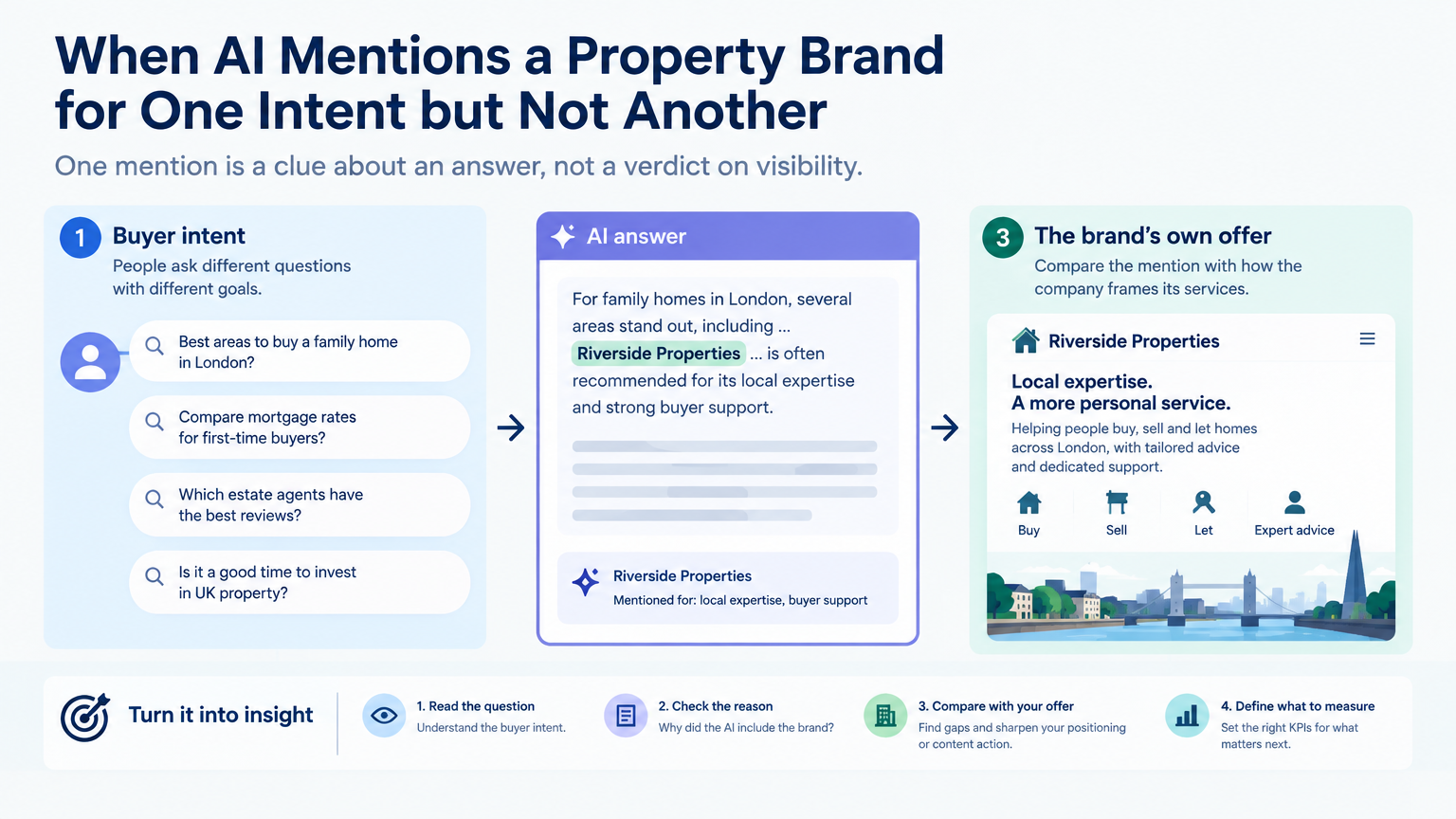
One mention is a clue about an answer, not a verdict on visibility
When a client spots a property brand in one AI answer and not in the next, the useful first question is not “How do we make the brand appear everywhere?” It is “What was the buyer trying to decide, and why did this answer include the brand?” A home seller comparing valuation, marketing and commission is not asking the same thing as a renter seeking a two-bedroom flat within a monthly budget or a first-time buyer looking for local transaction knowledge. Each question creates a different context for a recommendation.
That distinction matters in reporting. A brand mention records that the name appeared in an answer. A recommendation means the answer presents the brand as a possible choice for the stated need, perhaps with qualifications. A citation means a source was linked or referenced. These signals can overlap, but they are not interchangeable: an answer can mention a company without recommending it, recommend it without citing its website, or cite a company page without naming the company in its prose.
And none of those observations, on its own, shows that a person clicked, contacted an agent, listed a property or completed a transaction. Treat the answer as evidence of how a particular AI response represented a business for a particular question at a particular time. That is a useful marketing signal, but it is not a market ranking or a sales result.
This way of reading the evidence turns a potentially misleading headline, “We are visible in AI,” into a more useful client conversation: “We appeared in this answer for this buyer need, for this stated reason. Here is how that framing compares with the offer we publish, and here is the next question worth testing.”
Sources: Savills: public GEO observations; Habitat Property: public GEO observations
What the Hong Kong snapshots do, and do not, show
Two public Ready Scan observation sets, both captured on 20 October 2026, make the value of intent-specific reading concrete. Each set covers twelve answer observations across four buyer questions and three AI systems. The questions concern buying a second-hand home with clear information and commission terms, renting a two-bedroom home in Tseung Kwan O within a stated monthly budget, finding a starter home in Tuen Mun or Yuen Long with local estate and transport knowledge, and selling an owner-occupied home while comparing valuation, promotion and commission.
In the Savills set, the brand appeared in just one of the twelve answers: Gemini’s response to the home-selling question. It was a conditional recommendation, grouped with luxury specialists and described in the answer in connection with prestigious properties, bespoke marketing and high-net-worth buyer networks. The answer did not cite Savills’ website. The other eleven observations were assessed as absent.
In the Habitat Property set, the brand was not mentioned in any of the twelve answers. That is the result for this question set and capture, not a claim that Habitat Property is absent from AI answers generally.
| Brand snapshot | What appeared in the answers | What the snapshot supports |
|---|---|---|
| Savills | One conditional recommendation in Gemini’s answer to the seller question; no Savills website citation. | A dated observation of luxury-specialist framing for that specific answer. |
| Habitat Property | No brand mention across the twelve retained answers. | A dated, question-specific record of absence in this set. |
The counts are deliberately narrow. They describe these retained answers, not every answer available, every AI system, future visibility or a general competitive position. The snapshots also do not establish that one company performs better than the other. Their value here is to show why the exact question and answer wording matter when explaining what a visibility observation means.
Sources: Savills: public GEO observations; Habitat Property: public GEO observations
Compare the answer’s category with the company’s actual offer
The most useful part of the Savills observation is not simply that the name appeared. It is the reason the answer gave: luxury specialist, prestigious property, tailored marketing and access to high-net-worth buyer networks. That is a specific category and value story. It gives a marketer something concrete to compare with the company’s own published description.
The captured Savills residential page describes residential sales and leasing. For sales, it says Savills assists with residential acquisition or disposal according to an individual investment strategy or a diverse property portfolio approach, depending on client requirements. Read together, the page and the Gemini answer present adjacent but not identical frames. The answer emphasized a luxury-selling proposition; the page describes a broader residential service that includes both sales and leasing and frames acquisition or disposal around client strategy and portfolio needs.
That difference is a positioning question, not proof of a website problem. The answer does not cite the page, so the observation cannot show that the wording on the page caused the answer. Nor does it establish that a positioning edit would change later answers. The useful client question is whether the luxury-specialist frame is the intended front door for the buyer need being tested. If yes, marketers may want to make that offer and the supporting evidence easier to understand. If the business also wants to be considered for a broader owner-occupier sale decision, the team can assess whether its public materials clearly explain that service and its fit for that audience.
Habitat Property illustrates a different comparison. Its captured for-sale page presents a luxury-property offer through location, price, bedroom and feature filters, alongside agent recommendations. The observation set, however, asked broad questions about resale-agent terms, a budgeted rental, starter-home local knowledge, and the sale of an owner-occupied property. The brand’s absence in those answers can prompt a fit-and-language review: which of these needs does the company intend to serve, which does its published offer support, and which questions would better reflect its actual audience? The comparison does not establish that its site caused the absence or that any change will produce a mention.
The strongest positioning work begins by separating three things: the buyer’s need, the business’s actual offer, and the answer’s explanation of fit. Where they align, strengthen the specific evidence and wording that make the fit clear. Where they do not, decide whether the business should target a different need or explain the limits of its offer more clearly. Do not try to solve a strategic mismatch with generic visibility copy.
Sources: Savills: public GEO observations; Savills: public website context; Habitat Property: public GEO observations; Habitat Property: public website context
Turn the observation into a focused client decision
A useful client readout does more than count mentions. It connects the buyer question to the answer’s wording, the company’s offer and a specific next decision. A simple working record can keep those elements together:
| What to record | Why it matters |
|---|---|
| Exact buyer question and observation date | Shows the need and time context; makes a later retest comparable. |
| Full answer and brand role | Distinguishes a recommendation from a bare mention, citation or absence. |
| Answer’s stated reason for inclusion | Reveals the category, feature or audience the answer associated with the brand. |
| Relevant company-published service information | Lets the team compare answer framing with what the business actually says it offers. |
| Decision and next measure | Turns the observation into a positioning, content or research action without presuming an outcome. |
Then choose among a few practical paths. If the answer has captured an intended strength accurately, decide whether the brand should reinforce that position with clearer, substantiated service information. If the answer’s category is too narrow or misses an offer the business wants buyers to understand, review whether the company’s own pages explain that offer, its audience and its evidence clearly. If the need is outside the service scope, do not contort the positioning to pursue a mention. And if the evidence is ambiguous, refine the question set or gather more observations before commissioning a broad content project.
For a property seller comparing agents, an actionable content review might ask whether the company’s public materials make the relevant service legible: who it is for, what kinds of residential sales it covers, what support is offered, and how a seller can understand the next step. The answers should come from the company’s actual service and approved public information, not from assumptions imported from a single AI response. The job is not necessarily to publish a page targeting the wording of the prompt. It may be to make an existing service page clearer, provide a more precise explanation of the audience, or decide that the opportunity is not strategically important.
Keep measurement separate from the content decision. After a meaningful positioning or page change, rerun the same question with the same relevant context and, where possible, the same AI system. Preserve the complete answer and date. Look for whether the brand appears, what role it is given, and whether the explanation better matches the intended offer. A changed answer is a new observation, not proof that the edit caused the change. Repeated observations can help assess whether a pattern is emerging.
If the business objective is leads or listings, measure those outcomes independently through the company’s appropriate enquiry, CRM or transaction reporting. An AI answer observation can inform what to test; it cannot substitute for evidence that a customer arrived, enquired or transacted. This distinction is not a weakness in the client story. It allows the team to make a commercially useful recommendation without promising that a mention will produce revenue.
Sources: Savills: public GEO observations; Savills: public website context; Habitat Property: public GEO observations; Habitat Property: public website context
Sources
- Savills: public GEO observationsReady Scan · Accessed Explore publications using this source
- Savills: public website contextwww.savills.com.hk · Accessed Explore publications using this source
- Habitat Property: public GEO observationsReady Scan · Accessed Explore publications using this source
- Habitat Property: public website contextwww.habitat-property.com · Accessed Explore publications using this source