
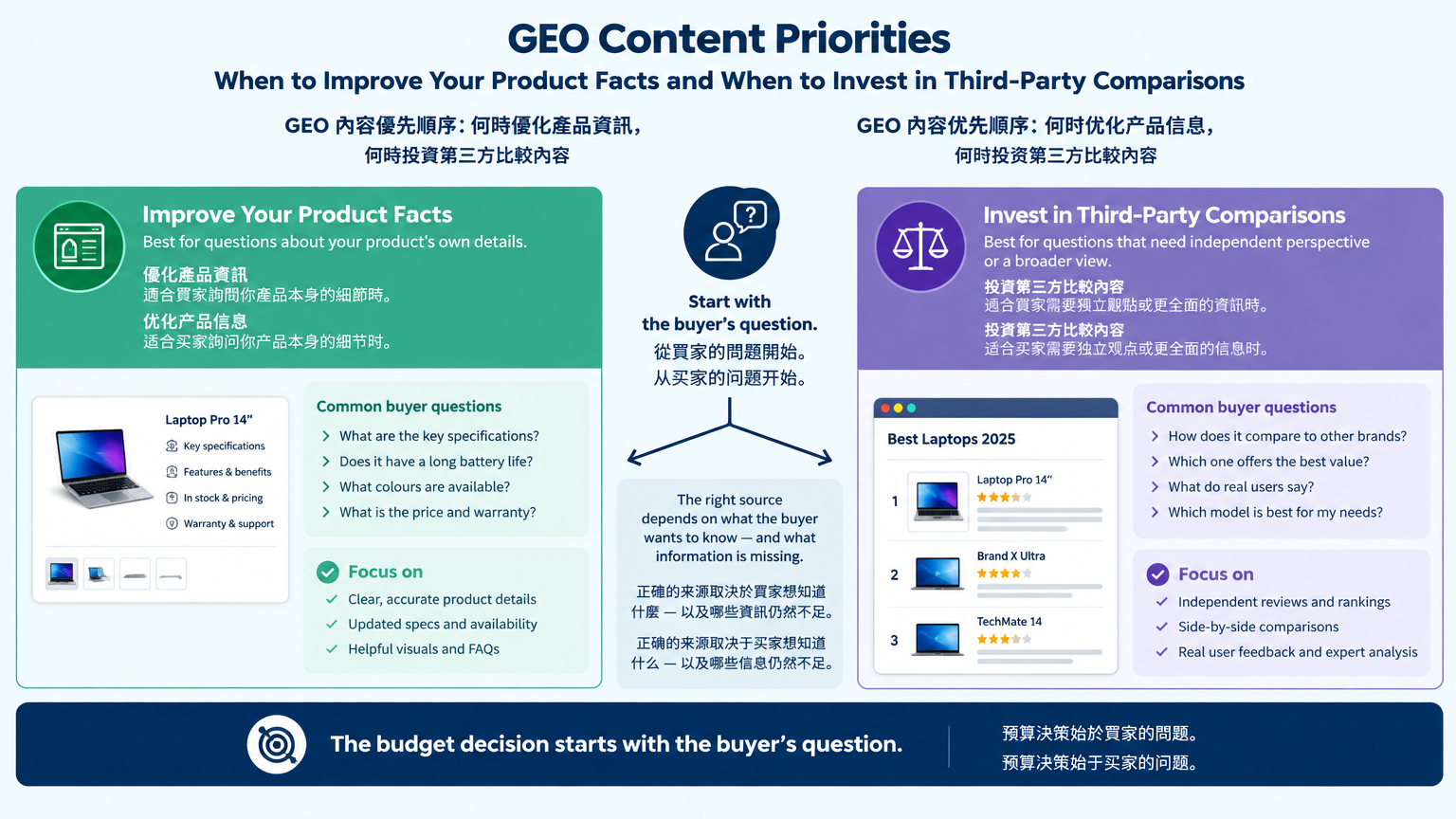
The budget decision starts with the buyer’s question
When an AI answer leaves your brand out, the obvious reaction is to publish more product information or seek more mentions elsewhere. Both can be sensible investments. Neither is a default fix. The useful question is: What is the buyer trying to establish, and what kind of source could credibly help answer it?
A buyer asking for a current price, a specific feature, compatibility, service scope or company policy is looking for a fact the company can usually define and verify. Your own site should be the dependable place to find that information. A buyer asking which option is best for a particular need, how two products compare, or whether a higher-priced choice is worth it is asking for a judgment across options. An official product page can explain what your offer includes, but it cannot by itself provide independent assessment of alternatives.
That difference gives marketers a useful starting point, not a rigid rule. Some questions combine fact-finding and comparison: “Which plan fits a small team, and what will it cost?” A buyer may need your current plan details and a credible comparison of how options differ. In that case, the two investments can complement each other. The point is to identify what each piece of work is meant to contribute instead of treating “first-party or third-party” as a single either-or decision.
Build a shortlist of real buyer questions from sources your team already has, such as sales-call notes, support requests, site-search terms, campaign queries and buyer interviews. Include the AI prompts you are monitoring when relevant, but label their source: an observed prompt is a useful signal to investigate, not by itself proof of wider buyer demand. This makes it easier to connect a content recommendation to both the buyer need and the evidence behind it.
Use three questions to frame the brief:
What task is the buyer completing? Finding a fact, checking eligibility, understanding an offer, comparing alternatives, or deciding whether a trade-off is worthwhile?
What information is missing or hard to assess? Is the company’s own answer unavailable, unclear or difficult to find? Or does the buyer need evaluation that the company is not well placed to supply on its own?
Who can credibly provide it? Your team owns product facts and can support them with approved information. Independent publishers, reviewers or comparison sites may contribute an outside assessment, provided the coverage is relevant and its basis is clear.
The strongest content recommendation may be to improve an existing page, seek better independent coverage, do both in a coordinated way, or hold off until the team can verify what buyers need. That is a more useful client decision than simply assigning a target number of new pages or brand mentions.
What the fan-out research can—and cannot—tell you
Ahrefs analyzed 66.6 million free, logged-out GPT-5.6 Luna responses from August and September 2026. In that dataset, 14.4% of responses contained fan-out queries, with about 1.6 fan-out queries on average among those responses. A fan-out query is a related search query generated as part of answering a user’s prompt. The figures are a snapshot of one model, setup and period, not a forecast of how every AI answer behaves. They do not show that every prompt triggers a search or that matching a fan-out guarantees a citation.
The study also points to a useful distinction between factual and comparative questions. In a separate test of 20,000 US prompts, factual questions about prices, features or company details more often cited an official source: 84.4% cited at least one official source, and 63.4% of citations were to official websites. For comparison questions, 68.3% cited at least one official source, while official sites accounted for 46.4% of citations. In other words, the mix shifted toward other sites for comparisons. This supports a sensible content hypothesis: make your own facts easy to find, and consider credible independent coverage when the buyer needs options weighed against each other. It does not prove what will happen for a specific company, category or platform.
Another finding needs similar care. In the fan-out dataset, 6.8% of fan-out queries used a site: operator. Among roughly 160 of the most-searched sites, 75.9% of those searches targeted a brand site. That is a reason to check whether essential product facts are available on your own site, not evidence that site: searches are the main retrieval method or that they cause recommendations.
The study reported that price and review fan-outs increased between August and September in its dataset. Those changes can suggest questions to inspect in your category. They are not, by themselves, a reason to commission price or review content. First confirm that the questions matter to your buyers and that your team can provide accurate, useful information. Treat the research as a way to sharpen a client conversation, then validate priorities against the actual prompts and sources relevant to your market.
Sources: How ChatGPT Does Query Fan-Out (15 Million Queries Studied)
Diagnose the gap before choosing the channel
Do not start with “We need a comparison article” or “We need to update the product page.” Start with a small set of real buyer questions and find where the answer breaks down. For a campaign or client account, group questions by the job they ask the answer to do. Useful groups often include:
Facts and verification: price, features, specifications, eligibility, availability, compatibility, policies or support details.
Fit and use: who a product or service suits, how it works in a buyer’s context, or what is included.
Evaluation: which option is better for a defined need, how alternatives differ, or what trade-off matters.
Evidence and experience: whether a claim is supported, how an option performs in practice, or what independent reviewers found.
Then inspect what is actually visible in the AI response and its cited sources, where available. A fan-out query can indicate what the system searched for in a particular observation; a cited page shows a source used in that answer. Neither tells you on its own why the source was selected or whether a content change will alter the result. Keep the full prompt, answer, source and relevant context together so the team is diagnosing the same buyer task, not a decontextualized mention.
Use the diagnosis to identify one of four gaps:
Missing company fact: A buyer needs a current detail the company controls, but the site does not provide it.
Unclear or hard-to-find fact: The information exists but is vague, outdated, buried, or difficult to access.
Missing comparative evidence: The buyer needs a credible assessment across options, and company-owned copy alone cannot supply an independent view.
No verified gap: The page already answers the need, the question is not relevant to the offer, or the observation is too thin to justify action.
This distinction prevents two common forms of waste. First, brands sometimes pursue third-party mentions when the basic price, feature or service detail on their own site is missing or inconsistent. Second, teams sometimes publish more first-party copy when the buyer’s real question is how the brand compares with alternatives and the company is not a neutral source for that judgment. Correctly identifying the gap makes the work easier to scope and the recommendation easier to defend.
Match the investment to the information only that source can provide
Once the gap is clear, give each channel a distinct job. Your company site should be the clearest, most maintainable home for facts the business owns. Independent coverage should add credible evaluation or context that the company cannot provide simply by repeating its own claims.
Improve first-party information when the company owns the answer. Review the relevant product, pricing, support or service page. Put the important fact in clear, accessible text, state conditions that change its meaning, and keep the page connected to the buyer’s next question. If prices vary by plan, location or configuration, explain the basis rather than presenting a figure without context. If a feature is limited to a particular tier or use case, say so. Assign an owner for updates so the information stays aligned with the actual offer.
A useful first-party fact is not just present; it is specific enough to answer the question. “Flexible pricing” does not settle what a buyer needs to know about cost. “Works with leading platforms” may not help someone verify a particular integration. Replace broad promotional language with details the team can support. Keep the explanation human-useful: a page should help a buyer understand the offer, not merely provide a fragment that can be extracted.
Invest in independent coverage when the buyer needs an outside judgment. Look for relevant reviewers, specialist publications, comparison sites or other credible sources that can assess meaningful differences. The objective is not to manufacture mentions or ask publishers to repeat approved marketing copy. It is to make sure buyers can find well-founded, independent information for the decision they are trying to make. Coverage is only valuable when the publisher is relevant to the audience and the comparison has a clear basis.
For a marketer or agency, that usually means supporting the conditions for accurate assessment: make product facts, specifications, documentation and access to appropriate experts available; respond to factual errors; and help the publisher understand what has changed. Do not ask for a favorable verdict, imply that coverage is guaranteed, or present a paid placement as independent assessment. If there is a commercial relationship, follow the applicable disclosure expectations and make the relationship clear.
Do both when the buyer needs facts and an outside comparison. Keep the company’s information current and consistent, then make the supporting material accessible to publishers who may evaluate the category. Coordinate facts and timing so independent comparisons are not working from stale details. Your site remains responsible for the company’s offer; the external source remains responsible for its own assessment. This division supports a more useful information environment without asking either source to play the other’s role.
Turn the diagnosis into a budgetable brief
A useful brief connects the buyer’s question to a specific change and a clear owner. It also makes the choice to do nothing defensible when the evidence does not support more production.
For each priority question, record:
Buyer task and wording: What is the buyer trying to decide or verify? Keep the question specific enough to guide an edit.
Current answer and destination: What does the company site say now, and which page should serve the need?
Evidence from the observation: If an AI response or source is part of the diagnosis, save the complete prompt, answer and cited material. Distinguish what was observed from what you infer.
Type of gap: Missing company fact, unclear information, missing independent evaluation, or no verified gap.
Recommended investment: Improve the canonical page, clarify or substantiate a claim, support relevant independent assessment, coordinate both, or defer pending better information.
Owner and completion condition: Who will approve and maintain the facts? What specific change will mark the work complete?
Review signal: What will the team check later, and which business outcome will be assessed separately?
A practical completion condition is more useful than a vague instruction such as “optimize for AI.” For example: the pricing page explains the current plan structure and the conditions that affect the quote; the product page specifies the supported integration and any relevant limits; or the comparison brief identifies which buyer need and alternatives an independent review should address. These are concrete editorial or partnership deliverables. They do not guarantee that an AI system will retrieve or cite them.
Prioritize work by buyer importance, the seriousness of the information gap, the company’s ability to support the claim, and the effort needed to create and maintain the fix. If a price or specification changes often, include the update process in the scope. If independent comparisons are sparse, consider whether the company can give publishers enough accurate, timely information to evaluate the product, without trying to control their conclusions. Budget for upkeep as well as production.
If the question is not relevant to the offer, or the answer is already clear and current, do not invent a content project to fill an AI-visibility plan. A measured “no change” can be the most responsible recommendation. It preserves budget for a real gap and gives the client a clear reason not to commission work that has no distinct buyer benefit.
Report visibility as an observation, not a promised outcome
The work can be measured without claiming that a content change caused an AI mention. Keep three layers distinct:
What you observed: a particular response mentioned the brand, cited a page, compared options, or did none of those. Preserve the prompt, response, source and relevant setup.
What you infer: the response may indicate that a specific buyer task is being answered with company facts or outside comparisons. This is a working interpretation, not proof of the retrieval process or cause.
What you will do: improve a defined page, support independent assessment, keep monitoring a meaningful question, or make no change.
For a first-party improvement, review whether the intended fact is accurate, current, easy to find and useful to a buyer. For independent coverage, review whether the publisher’s assessment is relevant, whether its basis is evident, and whether the resulting information addresses the buyer decision. These checks evaluate the work itself, even if a particular AI system’s outputs vary.
If the team checks AI answers again, use the same buyer questions and comparable settings where practical, and retain full answers rather than counting isolated mentions. Changes in the model, interface, location, prompt wording or source availability can affect what you see. Record those factors when possible. A mention, citation or fan-out query is a visibility observation, not evidence of a visit, lead or sale. Evaluate traffic, pipeline and revenue separately with the appropriate analytics or CRM data.
A clear client report should state what was changed, which buyer question it serves, what evidence supports the content, who owns future updates and what the team will review. If the outcome is uncertain, say so plainly. This makes GEO work commercially credible: the client can see the rationale, the deliverable and the next decision without being sold a guaranteed citation.
The decision is not “first-party content or third-party content” in the abstract. It is whether this buyer needs a fact the company should own, an outside judgment that independent sources can provide, or both. Make the company’s information accurate and findable. Invest in comparisons when the decision genuinely calls for them and credible coverage is achievable. Then judge the work by the information it improves and the buyer need it serves, not by a promise that one page or mention will determine AI visibility.
Sources: How ChatGPT Does Query Fan-Out (15 Million Queries Studied)