
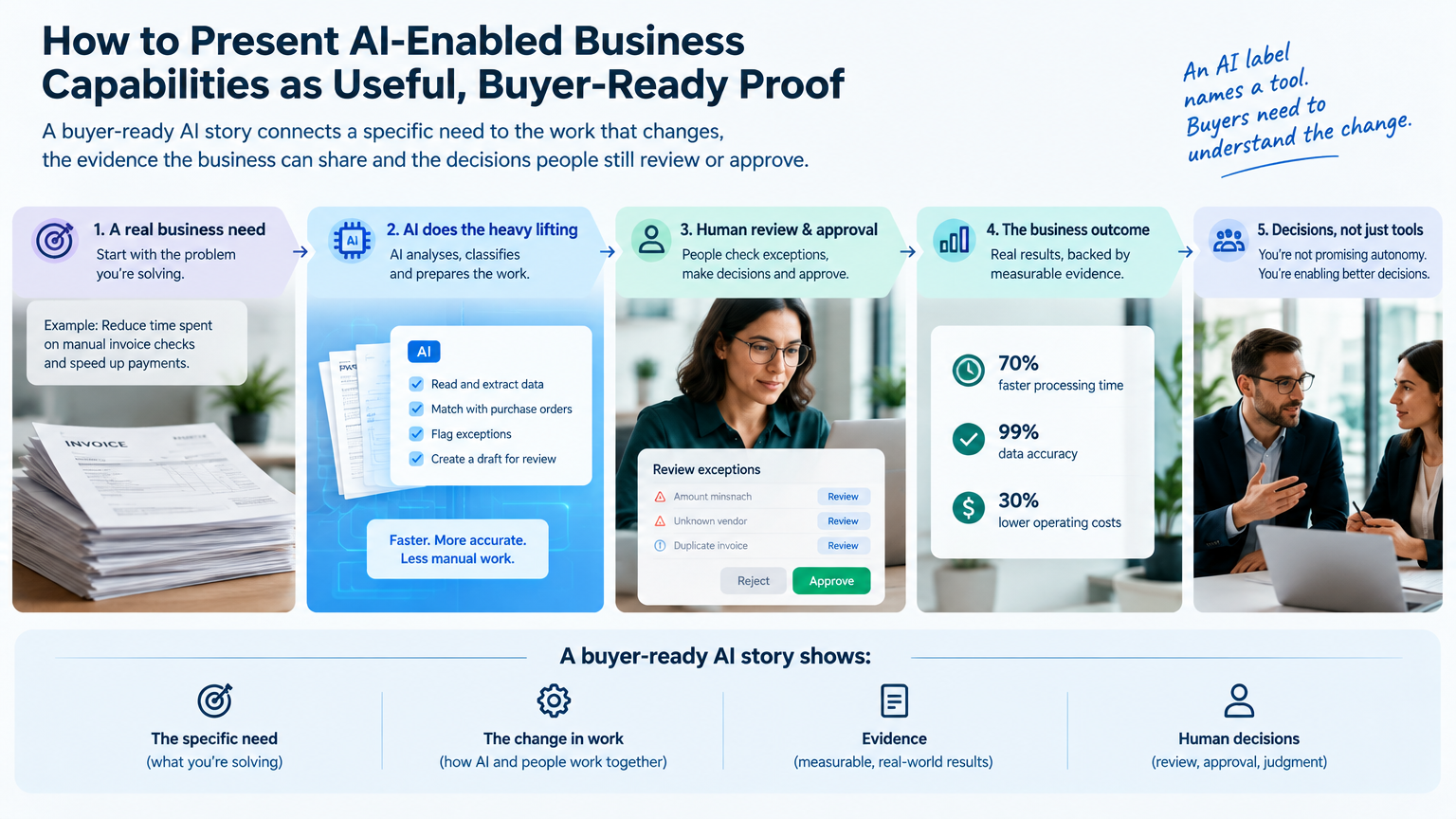
An AI label names a tool. Buyers need to understand the change.
“AI-powered” can attract attention, but it leaves the practical questions unanswered. What work does the capability support? Which part of the process changes? What can a customer, employee or business now do differently? And what evidence makes that account credible?
For marketers and agencies, the opportunity is to turn an internal technology story into a buyer-relevant explanation. That does not mean claiming that AI transforms an entire business whenever a team uses a model for one task. It means showing the connection between a real need and a specific change in work, then giving the reader enough evidence and context to assess its relevance.
A useful account has four connected parts:
The need: the customer, employee or business problem the work is intended to address.
The work: the process or task where AI provides support, including what changes and what does not.
The proof: a result, measure or concrete example that supports the claim being made.
The responsibility: the human review, approval or decision-making that remains part of the process.
These are not four promotional claims to stack onto a page. They are the logic that makes a capability understandable. A buyer looking at a property operator, for example, may care less that the company uses AI than whether it can bring homes to market more efficiently, assess property information at scale or maintain human control over decisions affecting its operations.
The same discipline helps when the audience is a client rather than a prospective customer. It gives the campaign team a basis to choose which claims belong on a landing page, which need a case study, and which are too broad to publish as written. Start with what the business can actually describe and support, not with the most impressive-sounding label.
Describe the workflow before you headline the capability
A capability becomes concrete when readers can picture where it enters the work and what happens around it. Describe the business process from the point of need to the decision or deliverable. Name the steps AI supports, the information it uses at a useful level of detail, and the role of the people who apply or review its output.
An OpenAI-published account of residential real estate operator Heimstaden illustrates this process-first approach. When a home becomes vacant, the letting process involves assessing rental value, preparing photography and advertisements, reviewing listings and responding to market feedback. Heimstaden describes AI support across several of these steps: pricing recommendations, image styling, apartment descriptions and feedback for letting teams. It also says agents review live ads against quality standards, while employees remain responsible for reviewing and approving decisions.
The same account describes a separate project: assessing environmental risks across Heimstaden’s property portfolio. Codex supported the discovery, cleaning and standardization of data, quality checks and repeatable processing pipelines. The analyst retained control over the methodology and validation. This distinction matters when presenting the capability: AI support for letting tasks and support for environmental-risk analysis are different workflows, with different outputs and review responsibilities.
That description gives a buyer a better basis for understanding the capability than a generic claim about AI-powered property management. It conveys connected workflows rather than suggesting one tool performs the whole job. It also makes clear that process support and human accountability coexist. For a company telling a similar story, the editorial task is to state the actual division of work precisely: what the system helps with, who checks the output, and who has authority to approve a decision.
A process account should be specific without becoming a technical inventory. Buyers generally need to understand the purpose and effect of a step, not the internal architecture behind every model call. A useful level of detail might explain that a system helps a team prepare a first draft or organize information for review. If the business can support it, say what the employee then verifies or decides. Do not imply that an output is automatically reliable, final or customer-ready unless that is genuinely how the workflow operates and the company can stand behind the statement.
This is also where marketers can make scope clear. “AI supports the letting process” could cover a wide range of activity. Naming pricing, image preparation, listing descriptions, ad checks and market feedback tells readers more, while the human-review detail prevents the account from implying unchecked automation. Describe a separate analysis workflow on its own terms, including its purpose and the expert checks involved. The result is not necessarily a longer claim; it is a more informative one.
Sources: Heimstaden is changing residential real estate management with AI | OpenAI; Accelerating engineering for the physical world | OpenAI; Computer for e-commerce is built for brand growth; Merge builds product and business tools with OpenAI technology | OpenAI; Teammates are agents for complex, ongoing work; Kuken Industries searches 70 years of drawings in minutes | OpenAI
Map review and approval responsibilities
Once the workflow is clear, map responsibility before adapting the story for a product page, case study or campaign. A useful accountability map distinguishes three roles: who checks the output, who can approve a consequential action, and who remains responsible for the customer or business decision. Those roles may belong to different people.
For each AI-supported step, record:
Input and output: What information goes in, and what does the system produce or recommend?
Review: Who checks the output, and what must they verify before it is used?
Approval and action: Which actions require approval, and who has authority to take them?
Escalation: What happens when information is missing, an output is unsuitable or a decision falls outside the agreed process?
Use this map to brief the people who own the workflow, then confirm that the public wording matches how the work actually operates. In campaign materials, distinguish a draft or recommendation from a reviewed deliverable, and do not describe a human check as approval if the person only checks a limited part of the process. If responsibility changes by task or market, make that scope clear.
For agencies, this is a practical client sign-off step: ask the process owner to confirm the workflow and evidence, and the appropriate decision-maker to approve the claims and any stated limits. Keep the approved description with the brief so landing pages, case studies and campaign copy use the same account. If the team cannot confirm a role or control, narrow the wording before publication. This gives buyers a clearer basis to judge how the capability fits their needs and gives the client a specific item to verify before launch.
Sources: Heimstaden is changing residential real estate management with AI | OpenAI; Accelerating engineering for the physical world | OpenAI; Computer for e-commerce is built for brand growth; Merge builds product and business tools with OpenAI technology | OpenAI; Teammates are agents for complex, ongoing work; Kuken Industries searches 70 years of drawings in minutes | OpenAI
Match evidence to the claim and the page
A product or capability page should help buyers understand the workflow and assess whether it fits their needs. A case study can show a supported result in context. Campaign content can focus on one question or decision. Choose evidence that supports the specific claim in each format, and avoid making an example of workflow sound like proof of performance.
Perplexity’s own e-commerce description illustrates a workflow, not an outcome benchmark. It describes using Shopify product and sales information to prepare a landing page, then aligning Meta ads and Klaviyo email with the same offer. The team reviews materials before publishing pages, sending emails or spending on ads. This can help an agency identify practical brief questions about product and offer facts, audience, channel roles, campaign limits, budget and approval points. The workflow itself does not establish campaign performance, revenue lift or time savings.
An OpenAI-published account of Merge offers a scoped operational measure. For executive dinners, Merge used a bot to find potential guests in its CRM and Apollo, check invitation history, prepare outreach, maintain an attendee tracker and suggest seating. Merge reported that preparing guest lists and outreach and maintaining the tracker went from dozens of hours across the company to about 30 minutes per event. The comparison covered the same planning tasks over the preceding three months. Ding reviewed the output, revised unsuitable wording and curated the guest list using relationship context the bot did not have; the team still handled hosting and relationship-building. This supports a claim about those planning tasks, not campaign lift, revenue or replacing human relationships.
Kuken Industries offers another example of keeping a measure tied to its task. OpenAI reports that Kuken engineers used a search tool to find a drawing for a replacement part in 4.5 minutes, down from nearly an hour. Kuken separately expected the tool to cut annual hours spent searching for drawings by about 90%. Engineers still checked tower specifications and replacement records to identify the right drawing. Keep the reported search time distinct from the projected annual reduction, and limit the claim to finding drawings in Kuken’s archive, not broader engineering performance or business results.
Keep distinct results tied to their actual scope. Heimstaden’s image-production cost example concerns virtually staged images in the Netherlands. Its asset-assessment example concerns analytical scale and estimated delivery effort. Neither supports a broader outcome the account does not report. Preserve relevant qualifications, such as market and whether a figure is an estimate, when using these examples.
For each proposed claim, ask what evidence supports it and whether that evidence belongs with this page or campaign. A workflow description can substantiate what the system supports and where review happens. A reported operational measure can support a claim about that work when its comparison and scope are clear. Neither should be stretched into an unsupported claim about customer outcomes or marketing performance.
Sources: Heimstaden is changing residential real estate management with AI | OpenAI; Accelerating engineering for the physical world | OpenAI; Computer for e-commerce is built for brand growth; Merge builds product and business tools with OpenAI technology | OpenAI; Teammates are agents for complex, ongoing work; Kuken Industries searches 70 years of drawings in minutes | OpenAI
Turn the account into useful website and campaign content
Once the workflow, evidence and responsibilities are clear, decide what each destination needs to do. A product or service page should explain the capability’s relevance to the offer and the buyer’s need. A case study should connect the business need and change in work to evidence that supports the stated result. Campaign content can address a focused question and point readers to the fuller explanation through the site’s usual navigation. Avoid forcing every detail into one headline or repeating the same case narrative in every format.
For an agency brief, record the priority audience and need, the workflow to describe, the proposed claim and its supporting evidence, the person who can confirm the process, and the page or campaign where the explanation belongs. Also state any conditions that affect the claim, such as the applicable market or whether a figure is estimated. Agree on who will approve the wording and what the reader should be able to understand or decide after seeing it.
Before publication, ask someone close to the process to confirm that the description reflects how the work operates. Have an editor check that the evidence supports the exact wording and that estimates, market-specific figures and illustrative examples retain their proper context. If a detail or responsibility cannot be confirmed, narrow the copy rather than filling the gap with a promise. Save the agreed description with the brief so related pages and campaign materials stay consistent.
For reporting, separate what the content explains from what happens after publication. A precise account may help buyers understand the capability, assess fit and decide what to ask next. Review those content and business objectives on their own terms. Do not treat a mention, citation or recommendation in an AI system as a guaranteed outcome of publishing the account; monitor such visibility separately if it matters to the client.
Sources: Heimstaden is changing residential real estate management with AI | OpenAI; Accelerating engineering for the physical world | OpenAI; Computer for e-commerce is built for brand growth; Merge builds product and business tools with OpenAI technology | OpenAI; Teammates are agents for complex, ongoing work; Kuken Industries searches 70 years of drawings in minutes | OpenAI
Sources
- Heimstaden is changing residential real estate management with AI | OpenAIOpenAI · Accessed Explore publications using this source
- Accelerating engineering for the physical world | OpenAIOpenAI · Accessed Explore publications using this source
- Computer for e-commerce is built for brand growthPerplexity · Accessed Explore publications using this source
- Merge builds product and business tools with OpenAI technology | OpenAIOpenAI · Accessed Explore publications using this source
- Teammates are agents for complex, ongoing workPerplexity · Accessed Explore publications using this source
- Kuken Industries searches 70 years of drawings in minutes | OpenAIOpenAI · Accessed Explore publications using this source