
Public observation context
Original report · Exact report snapshot
- Product
- Jolly Kingdom
- Observation language
- en-US
- Region
- Hong Kong
- Buyer questions
- 4
- Recorded narrative answers
- 12
- Completed narrative answers
- 12
- Supporting searches
- 4
- Full narrative observation period (UTC)
- 2026-10-20T05:10:43.109Z — 2026-10-20T05:12:17.552Z
- Narrative count by date (UTC)
- 2026-10-20: 12
- Report generated
- 2026-10-20T05:13:10.762Z
- Website source captured
- 2026-10-20T05:08:43.626Z
- Narrative models
- claude: anthropic/claude-haiku-5.5; chatgpt: openai/gpt-6-luna; gemini: google/gemini-3.7-flash
Original observation witnesses
Public observation context
Original report · Exact report snapshot
- Product
- English Excel
- Observation language
- en-US
- Region
- Hong Kong
- Buyer questions
- 4
- Recorded narrative answers
- 12
- Completed narrative answers
- 12
- Supporting searches
- 4
- Full narrative observation period (UTC)
- 2026-10-20T05:10:43.109Z — 2026-10-20T05:12:17.552Z
- Narrative count by date (UTC)
- 2026-10-20: 12
- Report generated
- 2026-10-20T05:14:42.250Z
- Website source captured
- 2026-10-20T05:12:29.334Z
- Narrative models
- chatgpt: openai/gpt-6-luna; claude: anthropic/claude-haiku-5.5; gemini: google/gemini-3.7-flash
Original observation witnesses
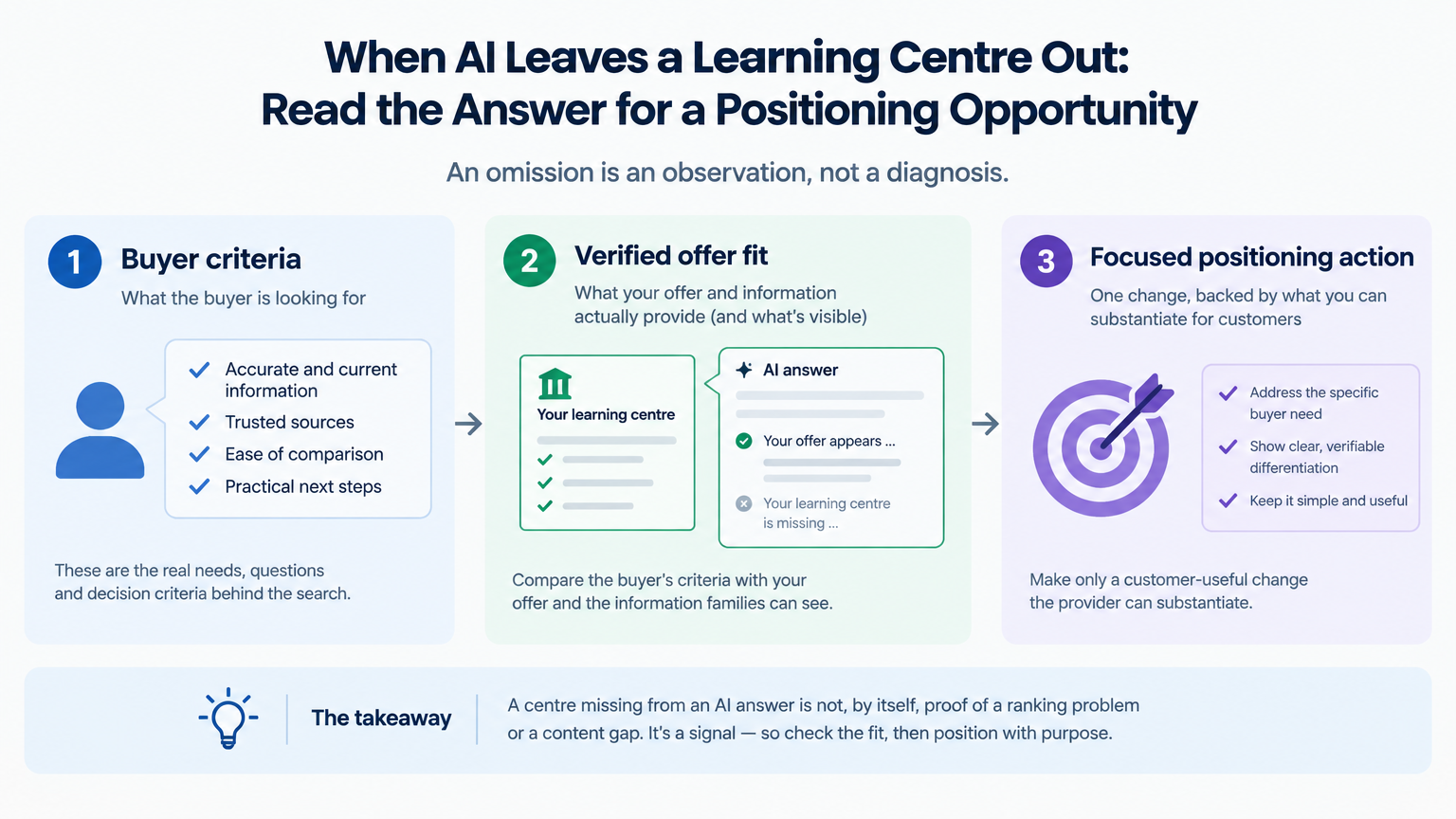
An omission is an observation, not a diagnosis
When a learning centre is missing from an AI recommendation, the client conversation can quickly become: “How do we get included?” That question jumps ahead. First ask what the parent was trying to choose, what criteria the answer used, and whether the centre’s actual offer fits those criteria.
For this example, the buyer asked about English writing courses for a Primary 4 pupil in Sha Tin. The question also raised a possible future move to a UK school. In three answers observed on 20 October 2026, ChatGPT, Claude and Gemini each named other providers and did not mention English Excel or cite its website. That is a specific, dated snapshot of those answers. It does not establish English Excel’s overall market position, explain why it was omitted, or show whether visibility later changed.
The distinction matters in agency work. “Not named” describes what happened in an answer. “The offer is a poor fit” is a judgement about the service. “The public information does not make the fit easy to recognize” is a hypothesis about how the offer is explained. One observation cannot settle the latter two. But it can give the team a useful place to investigate: the criteria the answers made salient, and whether the centre can accurately connect its offer to them.
Treat the answer as a record of how a system responded to one buyer question, not as a league table of learning centres. The practical goal is to discover whether there is a genuine, customer-relevant positioning decision to make, not to insert a provider into every list.
Compare the decision criteria, not just the names
The three answers did not make the same shortlist or explain the choice in the same way. ChatGPT compared MLC, Phonics Lab HK, British Council and Wiselad, drawing attention to writing practice, class size, course breadth and questions parents could ask about feedback. Claude included local, online and private-tutor options, emphasizing class size, composition feedback, fit with school assignments, format and cost. Gemini grouped options by broad teaching approaches and made more specific claims about providers.
That variation is more useful than a raw competitor count. It shows that the same broad request can be interpreted through different parent priorities. One answer may frame the choice around targeted writing practice and feedback. Another may make location, delivery format or cost more prominent. A third may categorize providers by teaching philosophy. Each framing suggests a different positioning question for the provider and the agency.
Use a simple answer-reading grid in client work:
Need: What is the parent trying to solve? Here, the expressed need is a Primary 4 English-writing course in Sha Tin.
Criteria: What does the answer make important? Note the criteria it actually mentions, rather than importing assumptions about what every parent wants.
Role of each option: Is a provider recommended for a specific reason, listed as one possibility, or included with qualifications? A name is not automatically an endorsement.
Evidence offered: What details does the answer use to explain fit? Are these specific, relevant to the question and attributable to the provider’s public information?
Unaddressed context: Did the answer take account of the possible UK-school move? In this snapshot, that circumstance was not consistently central.
This grid helps turn a seemingly simple absence into a commercial comparison. If an answer repeatedly emphasizes detailed composition feedback, the next question is not whether every centre should claim to offer it. Ask whether the centre provides that service at all. If not, it is a poor-fit criterion, not a gap to fill with copy. If the centre does have a relevant, documented offer, then examine whether its public pages explain it clearly enough for a parent comparing options.
The distinction protects both the client and the campaign. It avoids borrowing competitor language, implying services the centre does not provide, or treating a system’s particular shortlist as the market’s definitive view.
Sources: English Excel: public GEO observations; Jolly Kingdom: public GEO observations
Separate offer fit from information clarity
When a provider is absent, three explanations are worth separating before anyone writes a brief:
The offer does not match the need. The centre may not provide the specific kind of writing tuition, location, schedule or feedback the buyer wants. That is a product or service-fit issue. Content cannot make a missing capability real.
The offer may fit, but the connection is not explicit. A centre may serve the relevant age or level, or have an educational approach relevant to the question, while public pages do not clearly connect those facts to the parent’s situation. This is a positioning and explanation hypothesis to check.
The answer may have omitted the centre for reasons the observation cannot reveal. A short snapshot cannot identify the system’s selection process or prove that a change to a page would alter it.
For English Excel, the company’s public information describes individual learning plans built from worksheets and resources designed for Hong Kong students, materials that follow those used by UK schools as proficiency increases, small classes intended to encourage participation, and a free assessment booking. Those details give a marketer a legitimate starting point for reviewing how the offer is presented. They are company-published context, not features cited or claimed by the three observed answers.
The possible UK-school move deserves careful treatment. The answers did not consistently make it central, so marketers should not assume it caused the omission or that every family asking about writing courses needs UK-school preparation. It can still be a useful audience question: if a family wants to understand progression and curriculum context, does the centre’s public information explain what “materials follow those used in UK schools as proficiency increases” means in practice? What age or proficiency does the statement apply to, and how can a parent learn whether the approach suits a particular child? Those are clarification prompts, not a basis for claiming equivalence between curricula, assured transfer, or a defined outcome.
Likewise, an individual plan, small class or assessment may be relevant to a writing need, but the connection should not be overstated. The supplied company description does not establish that English Excel offers a dedicated writing course, composition marking, one-to-one writing feedback, or writing outcomes. If the centre does offer any of these, confirm and document that separately before making it a public claim. If not, keep the message to what it does support and help parents identify an appropriate next step, such as asking whether an assessment can clarify a student’s level and learning needs.
Sources: English Excel: public GEO observations; Jolly Kingdom: public GEO observations
Turn the observation into one useful positioning decision
A good response is not “publish more writing content.” It is to identify the buyer question, the centre’s verified offer, and the information a parent would need to judge fit. Then make one change, if a real and useful gap exists.
For an education provider, that review can be practical:
Name the audience precisely. If the offer is for Hong Kong primary students, say which age or level the relevant information applies to, where the provider can support that detail. Avoid implying that a broad resource bank equals a course designed for every writing need.
Describe the approach in buyer language. Explain what an individual learning plan is based on and how an assessment may help determine a suitable next step, but only to the extent the provider can confirm. Do not turn “individual plan” into a promise of individualized composition feedback unless that is an actual service.
Make progression understandable. Where the company describes materials following those used in UK schools as proficiency increases, explain the statement’s intended meaning, scope and limits in plain language. If a parent needs to know whether it connects to a particular school or transition, offer a direct way to ask rather than claiming a guaranteed match.
Keep writing claims specific and supportable. State whether writing is a dedicated course, one element of broader English learning, or not an advertised service. Be explicit about composition marking, feedback frequency or outcomes only if the centre confirms those details.
Give families a clear next step. If a free assessment can be booked, explain what a parent needs to do to book it and what the centre can confirm through that process. Avoid promising that the assessment will answer questions it is not designed to resolve.
The commercial value is not only the possibility of clearer AI representation. A parent comparing providers can also make a better-informed enquiry when the public offer explains who it is for, how learning is organized and what can be discussed before enrolment. That is a worthwhile outcome even if later AI answers do not change.
A useful client brief can be one page: the exact buyer question; the answer criteria observed; the provider’s confirmed offer; what is unclear or missing from public-facing information; and the smallest change that would help a parent decide. If review shows the centre does not serve a criterion such as dedicated composition marking, record that as a fit boundary. Do not write around it as if better wording could make the service exist.
Sources: English Excel: public GEO observations; Jolly Kingdom: public GEO observations
Retest the question, not a promised outcome
If the team makes a change, keep the original question and observation context alongside it. Retest the same buyer question when practical, record the date and platform, and retain the complete answer. If you change the wording, region or scenario, treat it as a new test rather than a clean before-and-after comparison.
Read the new answer for the same distinctions: Did the centre appear? Was it recommended for a reason, merely listed, or cited without being named? Did the answer address the parent’s actual criteria? Did the UK-school context become more prominent, stay peripheral or remain absent? A change in answer language can help guide the next review, but it does not prove that a page edit caused the change. Equally, an unchanged answer does not mean a customer-facing clarification was wasted.
For a client report, keep four things separate:
Observation: the dated question and full answer.
Interpretation: what buyer criteria and provider roles the answer shows.
Action: the specific information or positioning change, if any, and why it helps families.
Business outcome: enquiries, assessment bookings or enrolments, measured separately where the client has relevant data.
When a provider serves different ages or learning needs, keep each buyer question in its own row rather than rolling them into a generic English-visibility result. A Primary 1 phonics search, a Primary 2 reading-comprehension need beyond drills, a child hesitant to speak, and a Primary 4 writing search in Sha Tin call for different assessments of service fit. English Excel’s described individual learning plans, resources designed for Hong Kong students, materials that follow those used by UK schools as proficiency increases, small classes and free assessment booking can help frame useful questions for families. They do not establish a dedicated writing course or composition feedback, so confirm any such service before positioning it.
The next decision may be to clarify a supported fact, ask the provider to confirm a claim, monitor the same question, or do nothing because the offer is not a fit. That is a stronger outcome than turning every competitor name into a content assignment. The best positioning work makes the real offer easier for the right family to understand. It does not promise a place in an AI shortlist.
Sources: English Excel: public GEO observations; Jolly Kingdom: public GEO observations
Sources
- English Excel: public GEO observationsReady Scan · Accessed Explore publications using this source
- Jolly Kingdom: public GEO observationsReady Scan · Accessed Explore publications using this source