
Public observation context
Original report · Exact report snapshot
- Product
- Monkey Tree
- Observation language
- en-US
- Region
- Hong Kong
- Buyer questions
- 4
- Recorded narrative answers
- 12
- Completed narrative answers
- 12
- Supporting searches
- 4
- Full narrative observation period (UTC)
- 2026-10-20T05:10:43.109Z — 2026-10-20T05:12:17.552Z
- Narrative count by date (UTC)
- 2026-10-20: 12
- Report generated
- 2026-10-20T05:12:53.705Z
- Website source captured
- 2026-10-20T05:08:11.586Z
- Narrative models
- claude: anthropic/claude-haiku-5.5; chatgpt: openai/gpt-6-luna; gemini: google/gemini-3.7-flash
Original observation witnesses
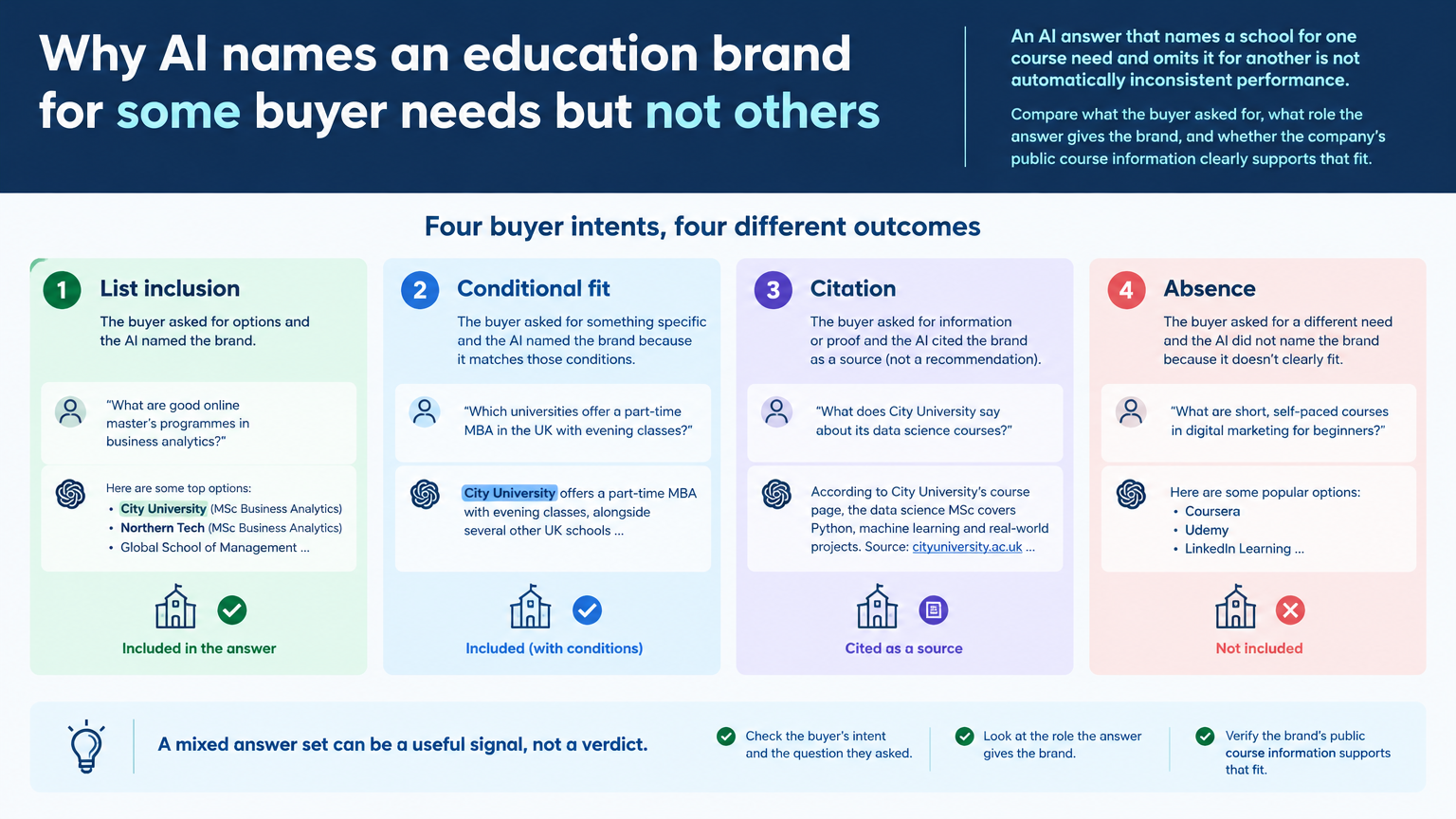
A mixed answer set can be a useful signal, not a verdict
When reading a mixed answer set, keep the buyer’s question beside each response. These four prompts describe distinct selection tasks: P1 phonics, P2 reading comprehension beyond drills, interactive speaking for a reluctant speaker, and P4 writing in Sha Tin. They are not interchangeable tests of a general “English class” query.
The criteria can differ too. A parent asking about comprehension may want to know what children read and how they discuss it; a speaking question puts interaction and chances to talk in focus; a district-specific writing question adds a location constraint. Treat these as clues about what the answer needs to establish, not as evidence that a particular course meets the need.
The table records what the three observed answers did for each prompt. Keep the original wording with the complete answers in client reporting. Three responses to one question are a useful snapshot for deciding what to check next, not a repeatable pattern or a general ranking.
Sources: Monkey Tree: public GEO observations
Compare the buyer’s task before comparing the answers
The snapshot shows a different pattern for each need. In the P1 phonics answers, Claude included Monkey Tree in a neutral list, Gemini gave it a conditional recommendation without a citation, and ChatGPT omitted it. For the P2 reading-comprehension question, Claude included and cited Monkey Tree, while ChatGPT and Gemini did not name it.
The speaking question produced a different result: all three answers named Monkey Tree, but their descriptions and assessments were not the same. For the P4 writing question in Sha Tin, only Gemini named it, presenting it as a possible fit for grammar and writing support. The other two answers omitted the brand.
| Buyer question | What the three observed answers did | A useful first interpretation |
|---|---|---|
| P1 phonics | Claude: neutral list inclusion. Gemini: conditional recommendation, no citation. ChatGPT: absent. | Presence ranged from a list entry to a qualified fit; those are not equivalent outcomes. |
| P2 reading comprehension beyond drills | Claude: included and cited. ChatGPT and Gemini: absent. | One answer made a connection, but the answer set does not show consistent inclusion across systems. |
| Interactive speaking for a child reluctant to speak | All three named the brand; descriptions and assessments differed. | Repeated mention is notable, but the wording still determines whether the fit is clear and accurate. |
| P4 writing in Sha Tin | Gemini alone named the brand as a possible grammar and writing fit. | Treat the specific course description as something to verify, not as confirmed company information. |
The table is a reading aid, not a scorecard. It prevents a broad statement such as ‘AI recommends the brand’ from flattening distinct observations. A name in a neutral list, a recommendation tied to a stated condition, a citation, and an omission each tell you something different. None, on its own, reveals why the system selected or left out the brand.
For a client discussion, keep the question wording beside each answer. The reading question includes a meaningful contrast, comprehension development beyond drills. The writing question adds a district and school level. Those specifics change what a useful recommendation needs to establish. Compare like with like before diagnosing a content issue, and don’t treat a result from one intent as a proxy for every course or buyer need.
Sources: Monkey Tree: public GEO observations
A citation, a recommendation and a course fact are not interchangeable
For the P2 question, Claude’s answer presented Monkey Tree’s Reading & Speaking course as suitable for ages 5–12 and described goals including confidence, fluency, vocabulary, reading and speaking. It also cited the brand’s public information. That is a meaningful observation: the answer connected a named course to a reading-related need and pointed to a company source.
It is not evidence that the public course description specifies a P2 reading-comprehension syllabus or particular comprehension activities. The supplied company information describes broader aims, but does not specify those details. That difference matters because the parent’s request is narrower than general reading and speaking development. An agency can report the answer’s connection without repeating it as a confirmed feature of the course.
Use three evidence layers in the client conversation:
What the AI answer says: its exact description, whether it recommends the brand, and any citation it includes.
What the company’s own information says: verified course ages, skills, activities and stated aims.
What the buyer needs to know: the specific information that would help assess fit, such as whether lessons include comprehension discussion or work beyond exercises.
A comparison of other providers’ published course descriptions can help sharpen the client conversation, too, but it should not be treated as evidence of why an AI system selected a brand. The supplied descriptions present Enrich English’s Reading Discovery as covering reading fluency and comprehension, with reading time, comprehension work and vocabulary exercises; they do not specify the P2 stage or activities such as inference, discussion or retelling. English Excel describes an age 3–18 programme, 1.5-hour classes and an Individual Learning Plan, but its published description does not specify P2 reading-comprehension content or story discussion. The British Council’s P1–P6 primary course is described as a broad English programme with group work and aims that include confidence, collaboration and critical thinking, rather than a comprehension-only course. These differences can help an agency identify what a parent might ask and how each offer is positioned; they do not establish a ranking or prove why any provider appeared in an AI answer.
The P4 writing answer makes the same discipline important. Gemini described a possible fit for grammar and writing support, but this observation alone does not establish that description as company-published course information. If the company’s current material confirms a relevant course, marketers can make the fit clearer using accurate details. If it does not, the answer is a prompt to check the description, not a fact to adopt in copy.
This prevents a common client-work mistake: allowing a polished AI summary to become the source of truth for a course page. An answer may be useful for identifying what a buyer expects, but the company’s current information should determine what the brand can claim. Where those two do not line up, preserve the distinction and ask the client to confirm the offer before recommending a content change.
Sources: Monkey Tree: public GEO observations
Choose the next step that matches the evidence
Mixed answers do not all call for the same intervention. Use a simple decision path: first ask whether the course genuinely fits the buyer’s stated need; then ask whether accurate public information makes that fit easy to understand. If both answers are yes, record the observation and avoid inventing a problem merely because another system gave a different answer.
For the P2 reading-comprehension need, start with the offer rather than the answer count. The company’s supplied description supports broad reading and speaking goals for ages 5–12, but does not spell out a P2 comprehension syllabus or the specific activities the parent asked about. If the course does include such activities, add accurate detail to the canonical course information: for example, the relevant age or level, skills practised, what learners do in class, and the intended fit. If it does not, describe the broader course honestly rather than stretching it to match a more specialized request.
For the speaking need, all three answers named Monkey Tree, but that does not make their differing descriptions interchangeable. Compare the answer wording with the company’s current course pages, then decide whether the public description already communicates the relevant speaking experience. If it does, record the repeated inclusion and monitor. If the detail is missing or unclear, improve the information that answers a real parent’s question, not just language that sounds likely to appear in an AI response.
For the Sha Tin writing need, Gemini’s answer may justify checking whether the relevant course and location information are clear and current. It does not, by itself, justify publishing a Grammar & Writing claim. Confirm that the course exists, is offered for the relevant level and district, and has the described content before changing the page. If there is no suitable offer, the result may simply reflect a weaker fit for that specific request.
A practical client workflow is to keep four fields for each intent: the exact buyer question; the observed role (recommended, listed, cited, or absent); the relevant company-published course information; and the next decision. That decision can be clarify the offer, improve accurate information for this need, or record and monitor. A question outside the service’s genuine scope may call for no change. Keeping these options open helps agencies avoid turning every AI variation into a rewrite brief.
Retest the question, not a convenient substitute
If you decide to improve course information, keep the change grounded in what the company can verify. Be specific about age or level, skills covered, learning activities and intended fit when those details are accurate and useful. Avoid implying that a broad reading-and-speaking course is a dedicated comprehension programme, or that a possible AI description confirms a particular writing syllabus. Clearer information serves parents directly, regardless of whether an AI answer changes.
For a later review, use the same buyer question and comparable observation conditions. Save the complete answers, date, system and any source references. Compare the answer’s wording and brand role, not just whether the name appeared. If the question changes from reading comprehension beyond drills to general English classes, it is a new buyer task, not a like-for-like retest. Likewise, a citation appearing in one answer is not the same outcome as a recommendation in another.
Then give the client an actionable readout: what the parent asked, what the answer actually said, what the company can confirm, and whether the next step is an offer clarification, a specific information improvement, or simply monitoring. For a Sha Tin P4 writing brief, compare the current published offer details against that exact need. The supplied company information describes the British Council’s P1–P6 primary course as a broader English course available in Sha Tin, but does not specify P4 writing genres, writing volume or feedback. English Excel describes an ages 3–18 programme with 1.5-hour classes and an Individual Learning Plan, but does not specify a P4 writing-focused class or a Sha Tin branch. Enrich English’s Writing Builders is described for primary students and sets out a staged writing programme, but the supplied information does not confirm a P4 entry level or Sha Tin availability. These are useful questions to take back to the providers, not evidence of relative quality or a reason any provider appeared in an AI answer.
Do not infer that a competitor’s activity, a campaign, or a page edit caused an observation without evidence. And do not promise that a content change will secure future inclusion or citations.
Mixed recommendations are most useful when they sharpen a positioning decision. For the parent seeking a P2 course that develops comprehension beyond drills, the question is not simply whether Monkey Tree appears. It is whether the course genuinely offers the kind of reading experience the parent seeks, and whether the company’s own information explains that accurately. That is a decision a marketer can help a client make, and a clearer one than chasing every appearance in an AI answer.
Sources
- Monkey Tree: public GEO observationsReady Scan · Accessed Explore publications using this source