
Public observation context
Original report · Exact report snapshot
- Product
- Tai Hing
- Observation language
- en-US
- Region
- Hong Kong
- Buyer questions
- 4
- Recorded narrative answers
- 12
- Completed narrative answers
- 12
- Supporting searches
- 4
- Full narrative observation period (UTC)
- 2026-10-29T05:07:39.471Z — 2026-10-29T05:21:40.039Z
- Narrative count by date (UTC)
- 2026-10-29: 12
- Report generated
- 2026-10-29T05:23:03.842Z
- Website source captured
- 2026-10-20T03:39:35.620Z
- Narrative models
- chatgpt: openai/gpt-6-luna; claude: anthropic/claude-haiku-5.5; gemini: google/gemini-3.7-flash
Original observation witnesses
Public observation context
Original report · Exact report snapshot
- Product
- TamJai SamGor
- Observation language
- en-US
- Region
- Hong Kong
- Buyer questions
- 4
- Recorded narrative answers
- 12
- Completed narrative answers
- 12
- Supporting searches
- 4
- Full narrative observation period (UTC)
- 2026-10-29T05:07:39.471Z — 2026-10-29T05:21:40.039Z
- Narrative count by date (UTC)
- 2026-10-29: 12
- Report generated
- 2026-10-29T05:23:25.620Z
- Website source captured
- 2026-10-20T03:48:45.122Z
- Narrative models
- chatgpt: openai/gpt-6-luna; claude: anthropic/claude-haiku-5.5; gemini: google/gemini-3.7-flash
Original observation witnesses
A brand mention is not yet a recommendation
For marketers, “the client appeared in an AI answer” is a starting point, not a performance conclusion. The answer may recommend the brand for a specific need, include it conditionally, list it neutrally for comparison, mention it in passing, or cite a page without naming the business. Those roles carry different weight and call for different next steps.
A useful way to read the answer is to ask what job the brand is being asked to do. Is it being presented as a strong fit, a reasonable option if a condition is met, one name among several, or merely a source for a detail? A mention establishes presence. A recommendation connects the offer to the buyer’s task. A citation indicates that a source appeared, but does not by itself establish that the business was recommended or that every answer claim is accurate.
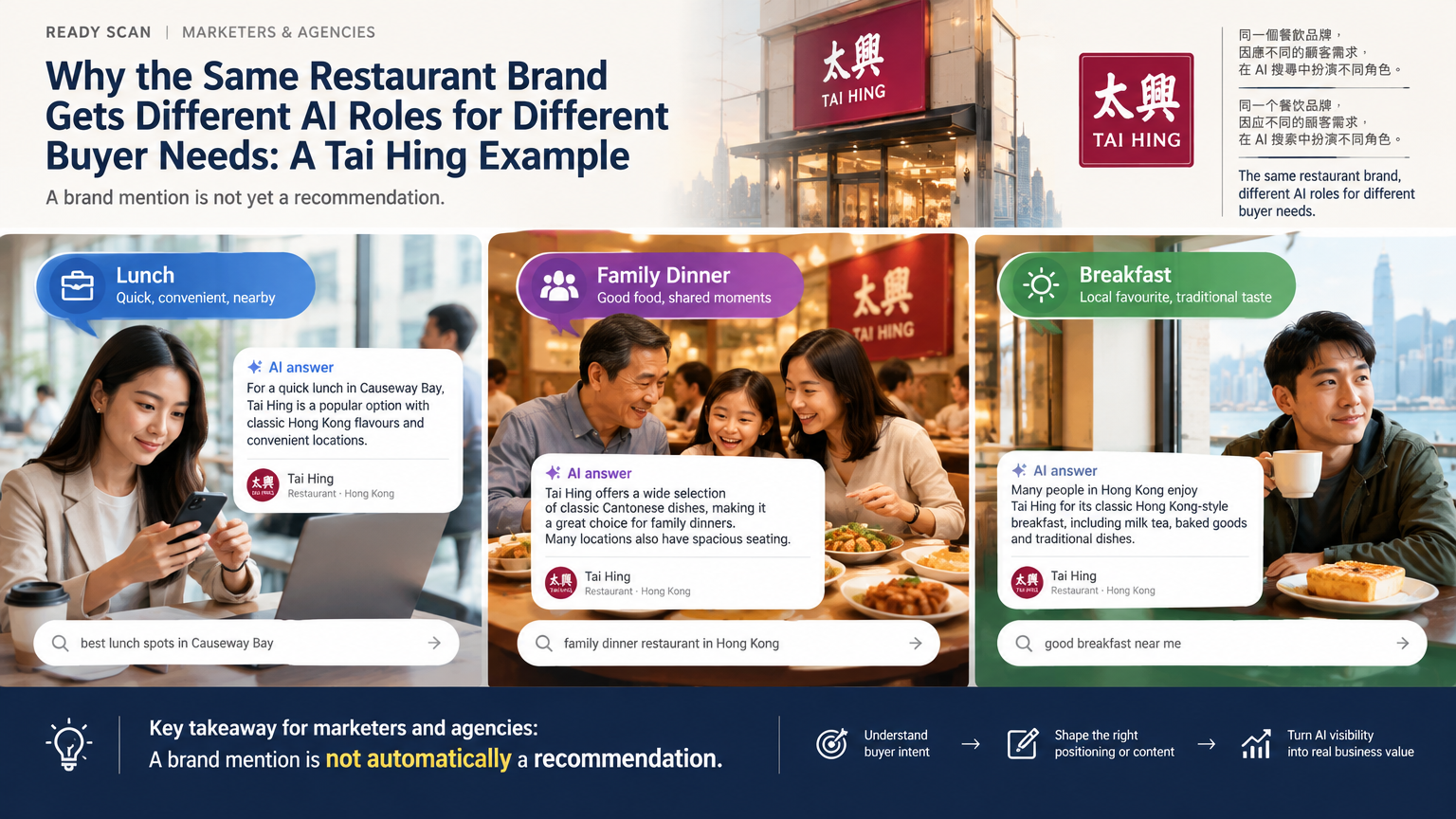
The Tai Hing example makes the distinction concrete. In a report snapshot dated 29 October 2026, Tai Hing appeared in three of twelve retained answers to four Hong Kong restaurant questions, and was recommended in two. The roles included a conditional lunch option, a family-dinner recommendation and a neutral breakfast comparison listing. Tai Hing was not cited as a source in any of the twelve answers.
That is more informative than flattening all three appearances into “AI recommends Tai Hing.” It is also more useful than reading the nine absences as a verdict on the whole brand. The sample describes these particular questions and answers, not market-wide visibility or the brand’s overall commercial strength.
Sources: Tai Hing: public GEO observations
Three buyer needs, three distinct roles
The questions in this snapshot did not ask for the same thing with different wording. Each set up a different buying task: a weekday lunch under HK$70 including a drink, a time-pressed lunch in Kwun Tong, dinner with family in Sha Tin at about HK$120 per person, and a breakfast comparison focused on range and clear pricing. The answers treated Tai Hing differently as those criteria changed.
| Buyer task | Tai Hing’s observed role | What the role actually says |
|---|---|---|
| Weekday lunch under HK$70, drink included | Gemini conditionally included Tai Hing as a possible near-budget option at particular branches. | The answer treated the fit as dependent on branch and price conditions, not as an unqualified budget guarantee. |
| Quick lunch in Kwun Tong | None of the three retained answers mentioned Tai Hing. | It was absent from these time-pressed local answers. That alone does not show why it was omitted or establish a speed disadvantage. |
| Family dinner in Sha Tin, around HK$120 per person | Gemini recommended Tai Hing as a roast-meat and home-style meal option. | The answer gave it a positive role for this particular occasion and location. Its stated spend and offer details remain answer claims to check. |
| Breakfast with varied choices and clear prices | Gemini listed Tai Hing in a comparison without expressing a preference. | It was a comparison alternative, not a distinct breakfast recommendation. |
This is intent-specific positioning in practice. A single brand can be a conditional fit for a price-led lunch, a more confident recommendation for a family dinner, and a neutral alternative for breakfast. “Visibility” alone does not capture that difference. The commercial question is which of these buyer needs matters to the business, and whether the role the answer assigns is the role the brand can credibly support.
The answer details are observations of what the systems said, not confirmation of every price, menu item, branch, service-speed or quality claim. In particular, the lunch and family-dinner spending figures came from Gemini’s answer. Treat them as a prompt to compare against current company-published offer information, not as verified price facts.
Sources: Tai Hing: public GEO observations; Tai Hing: public website context; TamJai SamGor: public GEO observations
The engine split matters as much as the intent split
Across the twelve answers, Gemini mentioned Tai Hing in three of four answers and recommended it in two. ChatGPT and Claude did not mention it in any of their four answers each. That contrast is a central part of the snapshot. A blended result could leave a client with the impression that “AI” has one stable view of the brand, when the observed answers differed by engine as well as by buyer task.
The pattern does not show why Gemini included Tai Hing or why the other systems did not. Nor does it establish that Gemini is generally more favorable, or that the split will persist. It does give marketers a practical reporting cue: keep platform-level results visible, and avoid rolling a small, mixed set of answers into a single brand verdict.
For a client readout, say what was observed in plain language: “In this question set, Gemini included Tai Hing for lunch, family dinner and breakfast, with different levels of endorsement; ChatGPT and Claude did not name it.” Then explain the limits: the cohort contains twelve retained answers across four questions and three engines, so it is not a market-wide visibility estimate. That is clear, commercially useful reporting without turning an isolated result into a claim about the entire category.
Sources: Tai Hing: public GEO observations; Tai Hing: public website context; TamJai SamGor: public GEO observations
Turn the role into a customer-useful decision
The best next step is not automatically to create more content. First decide which buyer need matters commercially, whether Tai Hing’s real offer fits it, and what a customer would need to verify that fit. The AI answer is a diagnostic prompt, not an instruction to imitate its wording or make a new claim.
Tai Hing’s public brand page describes it as a Hong Kong-style roast-meat restaurant and highlights simple, quick Hong Kong-style signature dishes. Use this as a factual positioning anchor when choosing which buyer task to prioritize, not as proof of a current branch-level price, speed or fit.
A practical review can work through three questions:
What exactly did the buyer ask for? Keep the full criteria together: price and drink inclusion, location and time pressure, or dinner occasion and per-person budget. A broad label such as “lunch” can hide the detail that shaped the answer.
Does the current offer genuinely meet those criteria? Compare the answer’s role with company-published offer information. Treat the company page as the company’s account of its offer, and AI wording as an answer observation. Do not use the answer itself to validate a price, menu item, branch, service speed or quality claim.
Can a customer readily find the relevant facts? If the offer fits but important details are hard to locate, improve the canonical information: for example, clarify which meal period or branches an offer applies to, what is included, and any relevant price conditions. If the facts are already clear, or the need is not a genuine fit, a new page may not be the right action.
For the lunch example, the useful question is not “Can we claim Tai Hing is under HK$70?” It is whether the actual menu and price conditions at relevant branches support that buyer need, including the drink. For the family-dinner example, check whether the published menu, branch information and suitable meal details support the family occasion and stated budget. Do not treat Gemini’s descriptions of roast meat, home-style meals or estimated spend as verified company facts without checking them against the company’s own information.
For the Kwun Tong speed question, omission should not become a speed claim in either direction. The snapshot shows only that Tai Hing did not appear in those three answers. It does not prove that speed caused the omission or that the business should reposition itself as faster. If rapid lunch is a priority, validate the real branch, service and ordering facts first, then decide whether the offer has a credible role for that task.
A small decision log keeps this work focused:
| Priority buyer need | Observed role | Check against the actual offer | Sensible next move |
|---|---|---|---|
| Budget weekday lunch | Conditional option | Current price, drink inclusion, meal period and branch conditions | Make confirmed details easier to find, if they are unclear |
| Fast local lunch | Absent in this sample | Relevant branch and real ordering or service information | Validate the fit; do not infer a speed problem or promise |
| Family dinner | Recommended by Gemini | Current menu, branch availability and whether the offer fits the stated occasion and budget | Clarify supported family-dinner information if a real gap exists |
| Breakfast comparison | Neutral listing | Breakfast range, current prices and what is included | Decide whether this is a priority positioning need before creating content |
The table is a decision aid, not a checklist that every brand must satisfy. Choose the task that matters, identify one customer-relevant uncertainty, and assign an owner to verify it. That can lead to a focused update, a product or offer clarification, a decision to monitor, or no change at all.
Sources: Tai Hing: public GEO observations; Tai Hing: public website context; TamJai SamGor: public GEO observations
Retest by intent, and keep the report honest
A useful follow-up holds the question steady. Re-run the same buyer task with the same relevant location, budget and meal criteria, and retain the full answers. If the prompt, model or setup changes, record that as a new observation rather than presenting it as a like-for-like comparison. Where a decision depends on a pattern, repeat the check instead of treating one answer as conclusive.
Keep the denominator visible. In this report, three of twelve retained answers mentioned Tai Hing and two of twelve recommended it. By intent, each question had three retained answers: Tai Hing appeared in one for the under-HK$70 lunch, none for the Kwun Tong speed-focused lunch, one for the Sha Tin family dinner, and one in the breakfast comparison. That detail helps explain the overall totals, but it does not increase the sample beyond the answers actually retained.
Citations deserve their own line in a report. Tai Hing was not cited as a source in any of these twelve answers, even though a brand can be mentioned without being cited or cited without being named. Keep that distinction clear. Likewise, a platform’s recommendation is not proof of customer visits, orders or revenue. If business impact is the question, review referral, ordering or sales data separately.
For an agency or in-house team, a compact readout can record the buyer question, engine, date, exact role and relevant excerpt, verified offer facts, the next decision and its owner. This makes it easier to brief a focused content or information update, or to explain why no change is warranted. The point is not to manufacture a favorable AI sentence. It is to make the client’s offer easier to understand for the buyer need that matters, then see whether the same kind of answer changes when checked again.
A dated snapshot is a starting point for that work, not a forecast. Attach the 29 October 2026 observation date to this example, verify current offer details before using them in customer-facing copy, and make the next decision based on the business’s real priorities rather than one mention, omission or platform.
Sources: Tai Hing: public GEO observations; Tai Hing: public website context; TamJai SamGor: public GEO observations
Sources
- Tai Hing: public GEO observationsReady Scan · Accessed Explore publications using this source
- Tai Hing: public website contextwww.taihing.com · Accessed Explore publications using this source
- TamJai SamGor: public GEO observationsReady Scan · Accessed Explore publications using this source