
Public observation context
Original report · Exact report snapshot
- Product
- Fairwood
- Observation language
- en-US
- Region
- Hong Kong
- Buyer questions
- 4
- Recorded narrative answers
- 12
- Completed narrative answers
- 12
- Supporting searches
- 4
- Full narrative observation period (UTC)
- 2026-10-29T05:07:39.471Z — 2026-10-29T06:09:07.106Z
- Narrative count by date (UTC)
- 2026-10-29: 12
- Report generated
- 2026-10-29T06:09:24.174Z
- Website source captured
- 2026-10-20T03:38:33.433Z
- Narrative models
- chatgpt: openai/gpt-6-luna; gemini: google/gemini-3.7-flash; claude: anthropic/claude-haiku-5.5
Original observation witnesses
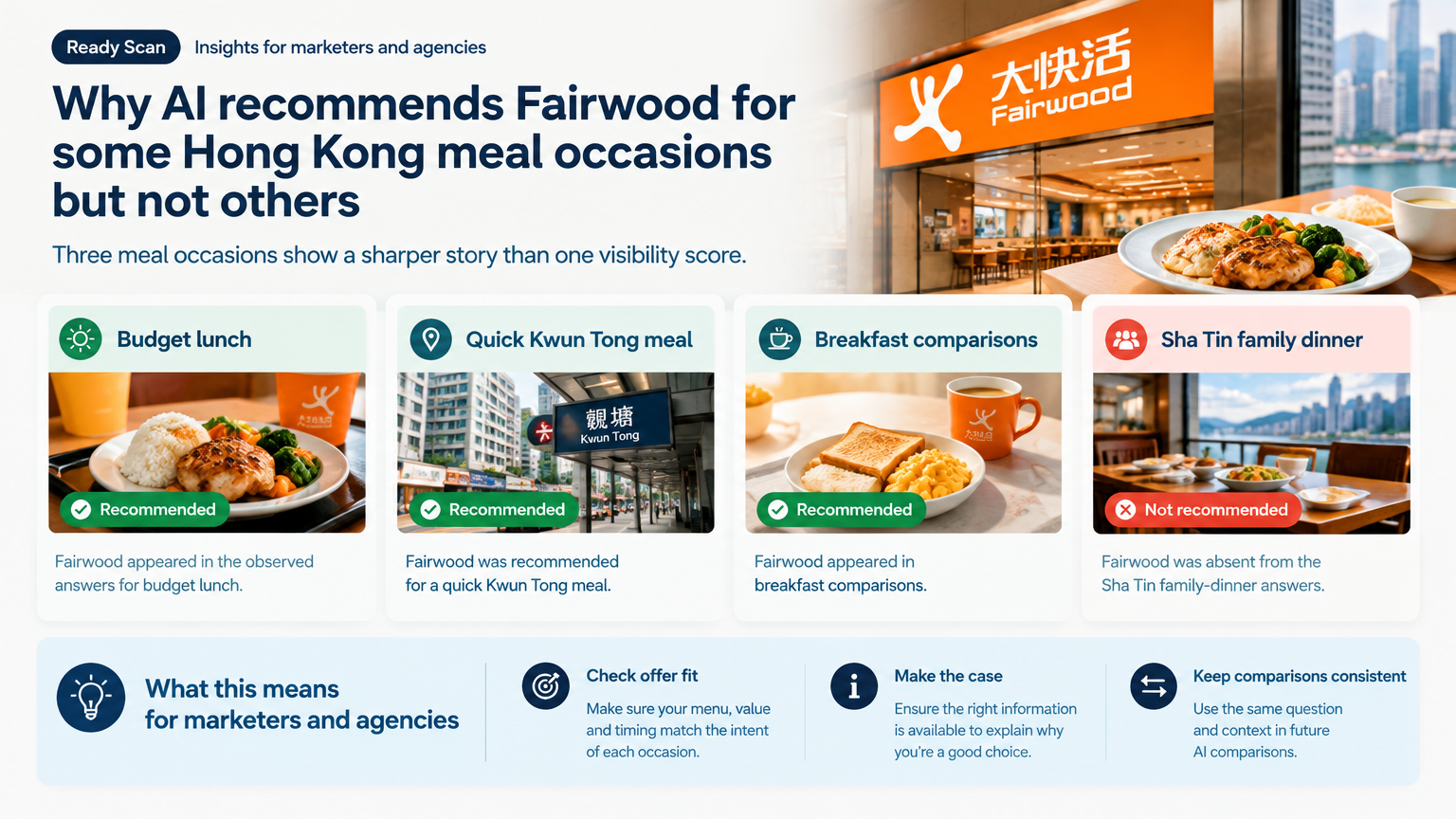
Three meal occasions show a sharper story than one visibility score
When Fairwood appears in some AI recommendations but not others, it is tempting to frame the issue as a broad visibility gap. But a person choosing a weekday lunch under HK$70 including a drink is solving a different problem from an office worker in Kwun Tong trying to eat quickly, someone comparing breakfast menus, or a family planning dinner in Sha Tin at around HK$120 per person. The relevant competitors, decision criteria and evidence can change with the occasion.
Ready Scan’s Fairwood observations, recorded on 29 October 2026, cover three answers for each of those four buyer questions. In the observed answers, Fairwood was mentioned and recommended for the budget weekday lunch and the quick Kwun Tong lunch. It appeared in two of the three breakfast answers, though its role varied. It did not appear in any of the three Sha Tin family-dinner answers.
That pattern is worth acting on, but not by treating every absence as the same problem. It suggests a stronger observed fit with everyday meal occasions than with this particular family-dinner request. It does not establish why the answers differed, prove that the dinner offer is unsuitable, or measure Fairwood’s overall visibility across Hong Kong. Think of the snapshot as a set of prompts for a focused positioning review, not a market verdict.
Sources: Fairwood: public GEO observations
The wording reveals what Fairwood is being considered for
A mention count tells you whether the name appeared. The answer’s wording tells you more about the role the brand played in the buyer’s decision.
For the weekday lunch under HK$70 including a drink, the answers associated Fairwood with budget fit, varied Hong Kong-style meals and visible menu pricing. For the Kwun Tong question, Fairwood was one option for a Hong Kong-style rice meal. The answers also named alternatives framed as faster or more convenient. That distinction matters: Fairwood was part of the consideration set, but the answer did not present it as the unequivocal fastest choice.
The breakfast answers offer a useful reminder to separate recommendation from citation. ChatGPT recommended Fairwood and cited its official menu. Gemini included Fairwood without a citation, while Claude did not mention it. Across the three answers, therefore, the brand’s breakfast role ranged from a supported recommendation to no mention. A menu citation can support a detail such as what the menu offers; on its own, it does not explain why the brand was selected or establish broad visibility.
The dinner answers set up a different comparison. The named alternatives were framed around family dining, different cuisines and sit-down occasions. That tells a marketer what kind of choice the answer was building, not that Fairwood cannot serve families or dinners. The next question is whether the company’s actual dinner offer, location and customer-facing information provide a compelling, verifiable fit for this occasion.
Sources: Fairwood: public GEO observations
Treat the Sha Tin absence as a diagnosis to make, not a page to rewrite
When a brand disappears from a question, start by unpacking the buyer task. “Family dinner in Sha Tin, about HK$120 per person” combines a location, occasion, group context and budget. The answers’ alternatives were described in terms of family dining and sit-down meals, while Fairwood was absent. That is enough to justify checking whether the offer is clearly represented for this need. It is not enough to conclude that a new family-dining page will change AI recommendations.
A practical review can separate three possibilities:
Offer fit: Does Fairwood actually provide dinner choices and a suitable experience for the family occasion and stated budget? If the offer is not a strong fit, do not manufacture a family-dining claim just to pursue a mention.
Information clarity: If the offer does fit, can a customer readily find the relevant dinner menu, current prices, branch details and any information that helps a group decide? Make only claims that the business’s current information supports.
Question and answer context: Did the wording emphasize a sit-down occasion or cuisine variety more than speed, familiarity or menu breadth? That may help explain why the answer set differed, but the snapshot does not establish cause.
This is a useful client conversation because it moves from “How do we get Fairwood mentioned?” to “Is family dinner a priority occasion we genuinely serve, and what would a customer need to know to choose us?” The answer might be a focused menu or branch-information improvement, a decision to test another family-dinner question, or a conclusion that this is not the right positioning opportunity. Each is more actionable than a blanket visibility target.
Sources: Fairwood: public GEO observations
Turn the pattern into a focused client plan
For an agency or in-house team, the report should help choose the next decision, not just present a score. Put each priority buyer question beside the role Fairwood played, the evidence a customer would need, and the owner of any follow-up. The question set suggests three different kinds of work:
Budget weekday lunch: The observed answers already connect Fairwood with budget fit and visible menu pricing. Check that the relevant menu information remains current and that the price and drink conditions are easy to understand. Avoid rewriting general lunch content unless there is a real information problem.
Quick Kwun Tong lunch: The answers included Fairwood as a Hong Kong-style rice-meal option, while alternatives were framed as faster or more convenient. If speed is the desired differentiator, verify what can be substantiated about branch location, ordering and collection. Do not claim a speed advantage that the business cannot support.
Breakfast: Fairwood appeared in two answers with different levels of endorsement, and one answer cited the official menu. Review whether breakfast variety and pricing are easy to find in current official information. A citation is useful context, not proof that every answer selected Fairwood for the same reason.
Sha Tin family dinner: First confirm whether the real offer and local availability suit the occasion and budget. Improve or organize relevant information only if a customer-facing gap is confirmed.
This approach keeps the work commercially grounded. The aim is not to create a page for every phrasing variation. It is to make a real offer easier to understand for a meaningful customer need, or to recognize when another occasion is a better fit.
Sources: Fairwood: public GEO observations
Retest like for like, and report what changed
A dated snapshot is a starting point, not a forecast. The report records three answers per question on 29 October 2026. Those observations do not establish market-wide prevalence, explain the cause of any recommendation, or show that a content change will produce a different answer.
For a useful follow-up, repeat the same buyer questions with the same location, occasion, budget and meal details. Preserve the full answers and record whether Fairwood was absent, mentioned, recommended, or cited as a source without being recommended. Keep those outcomes separate. If the prompt, model or other relevant setup changes, record it as a new observation rather than a direct before-and-after comparison.
A client readout can then be specific: the lunch questions show a recommendation pattern; the breakfast answers vary, and recommendation and citation do not line up in every answer; the family-dinner question produced three absences. From there, state what the team will verify or change, who owns it, and when the question will be retested. If no credible customer-facing gap or offer-fit opportunity is identified, “monitor” or “no change” is a valid decision.
Keep business outcomes separate. An AI recommendation does not prove a visit, order or sale. If the commercial question is whether visibility work contributes to results, review referral, ordering or sales data separately. The most useful next question is not simply “How do we get Fairwood mentioned more?” It is “For which meal occasion do we want Fairwood to be a useful recommendation, and what current, verifiable information helps a customer choose it?”
Sources: Fairwood: public GEO observations
Sources
- Fairwood: public GEO observationsReady Scan · Accessed Explore publications using this source